
JUVENILE DELINQUENCY
(COMIC BOOKS)
---------------------
WEDNESDAY, APRIL 21, 1954
UNITED STATES SENATE,
SUBCOMMITTEE OF THE COMMITTEE ON
THE JUDICIARY, TO INVESTIGATE JUVENILE DELINQUENCY,
NEW YORK, N.Y.
The subcommittee met at 10 a.m. pursuant to call, in room 110, United States Courthouse, New York, N.Y., Senator Robert C. Hendrickson (chairman of the subcommittee), presiding.
Present: Senators Hendrickson, Kefauver, and Hennings.
Also present: Herbert J. Hannoch, chief counsel; Herbert Wilson Beaser, associate chief counsel; and Richard Clendenen, executive director.
The CHAIRMAN. This meeting of the Senate Subcommittee Investigating Juvenile Delinquency will now be in order.
Today and Tomorrow the United States Senate Subcommittee Investigating Juvenile Delinquency, of which I am the chairman, is going into the problem of horror and crime comic books. By comic books, we mean pamphlets illustrating stories depicting crimes or dealing with horror and sadism. We shall not be talking about the comic strips that appear daily in most of our newspapers.
And we shall be limiting our investigation to those comic books dealing with crime and horror. Thus while there are more than a billion comic books sold in the United States each year, our subcommittee's interest lies in only a fraction of this publishing field.
Authorities agree that the majority of comic books are as harmless as soda pop. But hundreds of thousands of horror and crime comic books are peddled to our young ones of impressionable age.
You will learn during the course of these hearings that we shall also not be speaking of all crime comic books. Some of the types of crime and horror comic books with which are concerned have been brought into the hearing room for your attention.
I wish to state emphatically that freedom of the press is not as issue in this investigation. The members of this Senate subcommittee ─ Senator Kefauver, Senator Hennings, and Senator Langer ─ as well as myself as chairman, are fully aware of the long, hard, bitter fight that has been waged to achieve and preserve the freedom of the press, as well as the other freedoms in our Bill of Rights which we cherish in America.
We are not a subcommittee of blue nosed censors. We have no preconceived notions as to the possible need for new legislation. We want to find out what damage, if any, is being done to our children's minds by certain types of publications which contain a substantial degree of sadism, crime, and horror. This, and only this, is the task at hand.
Since last November the subcommittee has been holding many public hearings into the various facets of the whole problem of juvenile delinquency. The volume of delinquency among our young has been quite correctly called the shame of America. If the rising tide of juvenile delinquency continues, by 1960 more than one and a half million American youngsters from 10 though 17 years of age, will be in trouble with the law each year.
Our subcommittee is seeking honestly and earnestly to determine why so many young Americans are unable to adjust themselves into the lawful pattern of American Society. We are examining the reason why more and more of our youngsters steal automobiles, turn to vandalism, commit holdups, or become narcotic addicts.
The increase in craven crime committed by young Americans is rising at a frightening pace. We know that the great mass of our American children are not lawbreakers. Even the majority of those who get into trouble with our laws are not criminal by nature.
Nevertheless, more and more of our children are committing serious crimes. Our subcommittee is working diligently to seek out ways and means to check the trend and reverse the youth crime pattern.
We are perfectly aware that there is no simple solution the complex problem of juvenile delinquency. We know, too, that what makes the problem so complex is its great variety of causes and contributing factors. Our work is to study all these causes and contributing factors and to determine what action might be taken.
It would be wrong to assume that crime and horror comic books are the major cause of juvenile delinquency. It would be just as erroneous to state categorically that they have no effect whatsoever in aggravating the problem. We are here to determine what effect on the whole problem of causation crime and horror comic books do have.
From the mail that we received by the subcommittee, we are aware that thousands of American parents are greatly concerned about the possible detrimental influence certain types of crime and horror comic books have upon their children.
We firmly believe that the public has a right to the best knowledge regarding this matter. The public has the right to know who is producing this material and to know how the industry functions.
This phase of our investigation is but the first of several into questionable, or, should I say, disturbing phases of the mass media fields.
At a later date, the subcommittee will be attempting to determine what negative effects, if any, upon children, are exerted by other types of publications, by the radio, the television, and the movies. This is not to say that juvenile delinquency is wholly of even substantially the result of certain programs and subject matters presented by the mass media. But there can be no question that the media plays a significant role in the total problem.
I will now ask the assistant counsel to call the first witness.
Senator KEFAUVER. Mr. Chairman, before we call the first witness, I want to compliment the chairman upon a very excellent statement of the purposes of this subcommittee and of this hearing here.
I would like to reemphasize that I feel the congressional hearings must be related to something that the Federal Government has jurisdiction of. This subcommittee is looking into the violations of various federal laws, such as the Dyer Act, Mann Act, violations of the interstate commerce, and in connection with the subject matter under investigation we, of course, do have a postal statue which prohibits the mailing or using the mails for the distribution and dissemination of indecent and scurrilous literature which will be a part of the subject matter of this hearing.
The CHAIRMAN. That is correct, Senator.
Senator KEFAUVER. I think it is also important to point out that Mr. J. Edgar Hoover's report of yesterday shows that whereas the increase in population last year was 5 percent, crime had gone up 20 percent and the particularly large increase was in connection with burglary and stealing of automobiles.
The interesting point is that a large part of the burglaries was committed by juveniles. Also juveniles, according to the FBI report, comprise 53.6 percent of those arrested for stealing automobiles.
As the chairman said, we do not have all the answers, but I think that it is important to look into the various matters which Mr. Hoover and other experts do bring out in connection with the increase in juvenile delinquency; and certainly as to the horror and crime comics, not the good kind as the chairman said, but he various small part, most all the witnesses do have something to say about these.
We are not going into this hearing with the idea of condemning anybody or censoring the press or impairing the freedom of the press and bringing out in relation to a Federal statue something so that all of these experts on juvenile delinquency are talking about.
That is my understanding.
The CHAIRMAN. The Senator from Tennessee is entirely correct and the Chair wishes to congratulate and commend the Senator for his contribution.
Now, will the counsel call the first witness?
Mr. BEASER. Mr. Richard Clendenen.
The CHAIRMAN. Do you solemnly swear that the testimony you will give before the subcommittee of the Senate Committee on the Judiciary, will be the truth, the whole truth, and nothing but the truth, so help you God?
Mr. CLENDENEN. I do.
The CHAIRMAN. The Chair with pleasure announces the presence of the distinguished Senator from Missouri, Senator Hennings.
TESTIMONY OF RICHARD CLENDENEN, EXECUTIVE DIRECTOR, UNITED STATES SENATE SUBCOMMITTEE TO INVESTIGATE JUVENILE DELINQUENCY.
Mr. BEASER. For the record will you state your name, your address, and your present occupation?
Mr. CLENDENEN. My name is Richard Clendenen, 1445 Ogden Street NW., Washington, D.C.
I am executive director of the Senate Subcommittee To Investigate Juvenile Delinquency.
Mr. BEASER. Mr. Clendenen, will you outline briefly your education and experience in the field of juvenile delinquency?
The CHAIRMAN. Before Mr. Clendenen answers that question, I would like to say that the Senate Subcommittee on Juvenile Delinquency feels that we have a very able staff director.
Mr. CLENDENEN. Thank you.
Prior to coming to my present position I had worked in the United States Children's Bureau for a period of 7 years, and held there the position of Chief of the Juvenile Delinquency Branch.
Prior to that time I had served in administrative capacities in institutions for emotionally disturbed children and delinquent children and also have had experience as a probation officer in a juvenile court.
Mr. BEASER. You are a trained social worker?
Mr. CLENDENEN. I am.
Mr. BEASER. Speaking on behalf of the staff, have you conducted an investigation into the comic-book industry?
Mr. CLENDENEN. Yes sir; we have. Our investigation into the comic-book industry has been almost exclusively limited to those comics which themselves center about horror and crime.
The particular type of comics to which I refer present both pictures and stories which relate to almost all types of crime and in many instances those crimes are committed through extremely cruel, sadistic, and punitive kinds of acts.
Now, in connection with that question, I should like to make it perfectly clear that our investigation has not been concerned with other types of comics, many of which all authorities seem to agree represent not only harmless, but many times educational entertainment.
I should also add that even within that type of comic books known as the horror crime comics, there are gradations within this group, too. That is, some are much more sadistic, much more lurid, than others in the same class or category.
Now, although our investigations have been limited to this particular segment of the comic-book industry, we should not give the impression that this is a small portion of the comic-book industry.
According to estimates which were provided us by the Audit Bureau of Circulations and the Controlled Circulation Audits, the two firms that publish circulation figures, there were about 422 different kinds of comic or comic-book titles on the newsstands in March 1954.
About one-forth were of the crime and horror variety.
Now, as far as all comic books are concerned, although exact figures are lacking, most authorities agree that there are probably somewhere between 75 million and 100 million comic books sold in this country each month.
If one-quarter of these are of the crime variety of comics, this means that there are some 20 million comic books, crime comic books placed on the newsstands of this country each month.
Mr. BEASER. When you say crime and horror comics could you be more specific in describing what you are talking about?
Mr. CLENDENEN. Well, we have prepared a certain number of slides which show pictures taken from comic books of the type to which we have addressed ourselves.
Now, I would like, for the purpose of illustration, to relate very briefly in summary fashion 6 stories, together with pictures illustrating these 6 stories which will give you a sampling of the type of comic books that we are talking about here.
Now, in presenting these I would like to say that while it is not a random sampling actually it is a deliberate sampling in trying to present the various types of stories and pictures that appear.
These are not typical, rather they are quite typical of the stories and pictures which appear in this type of publication. The first such crime comic is entitled "Black Magic."
This is a picture showing the cover or title page of this comic. Now, one story in this comic is entitled "Sanctuary," and the cover shots relate to this particular story.
You will note that this shot shows certain inhabitants of this sanctuary which is rally a sort of sanitarium for freaks where freaks can be isolated from other persons in society.
You will note 1 man in the picture has 2 heads and 4 arms, another body extends only to the bottom of his rib. But the greatest horror of all the freaks in the sanctuary is the attractive looking girl in the center of the picture who disguises her grotesque body in a suit of foam rubber.
The final picture shows a young doctor in the sanitarium as he sees the girl he loves without her disguise.
The story closes as the doctor fires bullet after bullet into the girl's misshapen body.
Now, that is an example of a comic of the horror variety.
The next slide, the second story, is the cover shot of a comic entitled "Fight Against Crime."
One story in this particular issue is entitled "Stick in the Mud". This is a story of a very sadistic schoolteacher who is cruel to all of the children in her classroom with only one exception. The one exception is the son of a well-to-do man who has lost his wife. Through her attentions to the son the teacher woos and weds the father.
The following picture shows the school teacher as she stabs her husband to death in order to inherit his money. She then disguises her crime by dragging his body into a bullpen where his corpse is mangled and gored.
The small son, suspecting his stepmother, runs away so that she will chase him into the woods where a bed of quicksand is located.
Our last picture shows the stepmother sinking into the quicksand and crying for help. The small son gets the stepmother to confess that she murdered his father by pretending he will go for help if she does so.
After her confession he refuses to go for help and stays to watch his stepmother die in the quicksand.
The next comic is entitled "Mysterious Adventures." This particular issue of which this is a cover shot contains a total of 6 stories in which 11 people die violent deaths.
One story, I think, in this particular issue, has to deal with a confirmed alcoholic who spends all his wife can earn on alcohol.
As a result their small son is severely neglected. On the day this small son is to start in the first grade in school the mother asks his father to escort him to the school. Instead the father goes to his favorite bootlegger and the son goes to school by himself. En route he is struck and killed by an automobile.
Informed of the accident, she returns to find her husband gloating over his new supply of liquor.
This next picture shows the mother kill her alcoholic spouse with an ax. She then cuts up his body into small pieces and disposes of it by placing the various pieces in the bottles of liquor her husband had purchased.
If you will look at the picture in the lower right-hand panel, you will see an ear in one bottle, an eye in another, and a finger in another, and so forth.
Senator HENNINGS. I wonder if Mr. Clendenen has any figures on the relative circulation or sale of this character of things as against the more innocuous kind of comics? To what extent, in other words, do these appeal to the children to a greater or less degree than the kind we are more or less familiar with, the harmless comic strips?
Mr. CLENDENEN. Well, about one-forth of the total comic-book titles, that is the different comic books are the crime and horror variety.
Now, perhaps not all of those are as rough as some of these that are shown.
On the other hand, this does constitute a not insubstantial segment of the comic-book industry.
Mr. BEARER. It is about 20 million a month, Senator Kefauver suggests.
Mr. CLENDENEN. That is right; 20 million a month of the crime and horror variety.
The CHAIRMAN. The Senator from Tennessee.
Senator KEFAUVER. Do I understand, Mr. Chairman, the 20 million per month is the number sold or placed on sale? How do you get that figure, Mr. Clendenen?
Mr. CLENDENEN. That is a circulation figure which refers to sales.
The CHAIRMAN. Distribution and sales?
Mr. CLENDENEN. Yes, sir.
Senator KEFAUVER. Is that from the industry itself?
Mr. CLENDENEN. No, sir; those figures, Senator, are from Audit Bureau of Circulations and the Controlled Circulation Audits.
The two organizations are companies that collect and issue data on circulations of various kinds of magazines.
Senator KEFAUVER. Thank you, Mr. Clendenen.
The CHAIRMAN. Does the Senator from Missouri have any more questions?
Senator HENNINGS. I just wanted to ask Mr. Clendenen another question and I do not what to break into his fine presentation of this ─ The Yellow Kid was the first comic strip, was it not?
Mr. CLENDENEN. Yes, sir.
Senator HENNINGS. Then we went into the Happy Holligan and Katzenjammers and the ones we used to think were funny as youngsters.
At any rate, the funnies we knew were really funny, there were things in them that were calculated at least to amuse. The daily papers throughout the country nowadays carry more and more of the so-called serials, whether they deal with crime or whether they deal with romance or whether they deal with one thing or another, they are more stories now and less of the old comic-strip variety.
Have you any material on that transition and any observations to make as to why obviously that must appeal to the public, or they would not run these syndicated strips in the papers as they do.
What is your view of that, Mr. Clendenen? Why has the public taste changed so apparently? Are we advancing or progressing in that sort of thing, or is it the obverse?
Mr. CLENDENEN. There really, or course, are not research base data on which an answer to your question could be founded. I am not sure whether the public taste has changed or not.
Certainly the comic-book industry which was born in and of itself during the depression years of the thirties, the latter thirties, represented perhaps rather than reflected any change in the taste of the public, represents a new idea, that is, to put the comics up in book form of this kind.
Just exactly why you have had a transition from the type of comics - and now I refer to comic strips, which appeared in an earlier day and on which each separate day represented a separate episode and were funny to the serious type of strip ─ I don't have any idea and no opinion on it.
I am not at all sure I said, and if I failed to say, I would like to say, that our investigation has not pertained at all to the comic strips appearing in the daily newspapers rather the comic books.
Senator HENNINGS. Thank you.
Mr. CLENDENEN. The next slide, the next comic that we would like to present to you is entitled "Crime Must Pay the Penalty". This particular comic has 4 stories in which 27 people meet a violent death. One story in this particular issue called "Frisco Mary" concerns an attractive and glamorous young woman who gains control of a California underworld gang. Under her leadership the gang embarks on a series of holdups marked for their ruthlessness and violence.
Our next picture shows Mary emptying her submachine gun into the body of an already wounded police officer after the officer had created an alarm thereby reduced the gang's take in a bank hold up to a mere $25,000.
Now, in fairness it should be added that Mary finally dies in the gas chamber following a violent and lucrative criminal career.
Now, this is strictly of the crime variety.
The next comic is entitled "Strange Tales" and has five stories in which 13 people die violently. The story actually begins with a man dying on the operating table because the attending doctor is so absorbed in his own troubles that he pays no attention whatsoever to his patient.
It develops that this is the story of a promising young surgeon who begins to operate on wounded criminals to gain the money demanded by his spendthrift wife.
After he has ruined his professional career by becoming associated with the underworld, the criminal comes to get help for his girl friend who has been shot by the police. When the girl is placed upon the operating table the doctor discovers that the criminal girl friend is none other than his own wife.
This picture shows the doctor, first of all, as he recognizes his wife, and as he commits suicide by plunging a scalpel into his own chest.
His wife also dies on the operating table for lack of medical attention.
The next comic, The Haunt of Fear, has 4 stories in which 8 people die violently. One story entitled "Head-Room" has to do with a spinster who operates a cheap waterfront hotel. The renter of one room is a man she would like to marry.
To win his favor she reduces his rent by letting his room, during daytime hours, to an ugly and vicious appearing man. This shot shows her renting the room to that individual.
Meanwhile there are daily reports that a murderer is loose in the city who cuts off and carries away his victim's heads.
The hotelkeeper suspects the vicious appearing daytime roomer and searches his room where she discovers six heads hanging on hooks in the closet.
She is discovered there by her favorite roomer who is returning to the hotel for the night.
It develops that he is the murderer and the next picture shows the hotelkeeper's head being added to the closet collection.
From a psychological point of view, however, there is another story in this same issue which is really even more perturbing. This is the story of an orphan boy who is placed from an orphanage to live with nice-appearing foster parents.
The foster parents give excellent care and pay particular attention to his physical health, insisting that he eat nourishing food in abundance.
A month later the boy discovers the reason for their solicitude when they sneak into his room at night and announce they are vampires about to drink his rich red blood.
It might be said that right triumphs in the end, however, since the boy turns into a werewolf and kills and eats his foster parents.
The final story is one entitled "Shock Suspense Stories." It contains 4 stories in which 6 persons die violently.
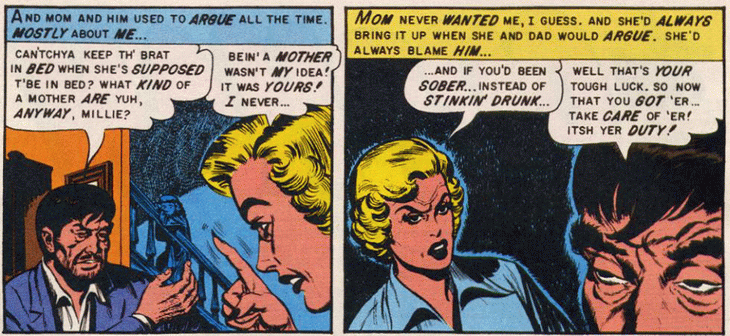
One particular story in this issue is called "Orphan." This is the story of a small golden-haired girl named Lucy, of perhaps 8 or 10 years of age, and the story is told in her own words.
Lucy hates both her parents. Her father is an alcoholic who beats her when drunk.
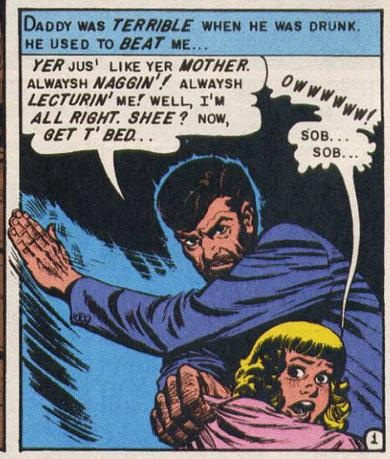
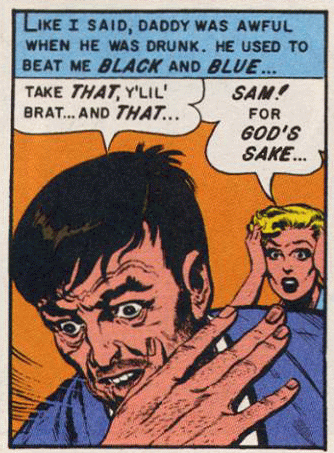
Her mother, who never wanted Lucy, has a secret boy friend. The only bright spot in Lucy's life is her Aunt Kate, with whom she would like to live.
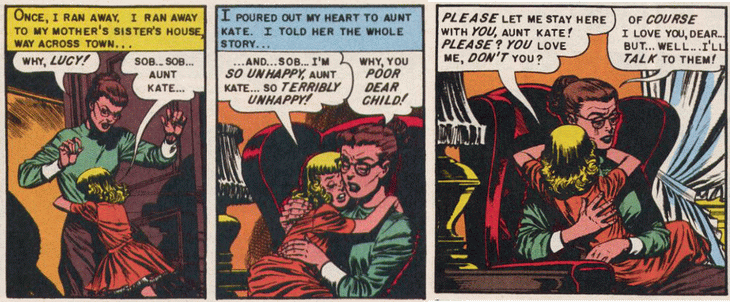
Lucy's chance to alter the situation comes when the father entering the front gate to the home meets his wife who is running away with the other man. Snatching a gun from the night table, Lucy shoots her father from the window.
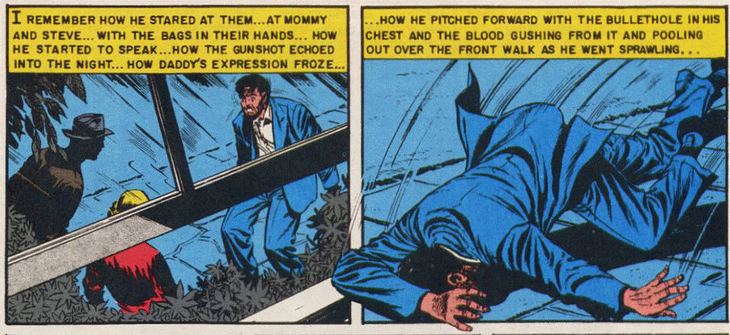
She then runs out into the yard and presses the gun into the hands of her mother who has fainted and lies unconscious on the ground.
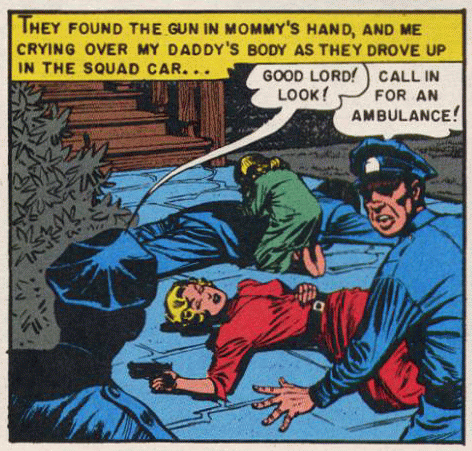
Then through Lucy's perjured testimony at the following trial, both the mother and her boy friend are convicted of murdering the father and are electrocuted.
This picture shows, first, "Mommie" and then "Stevie" as they die in the electric chair.The latter two pictures show Lucy's joyous contentment that it has all worked out as she had planned and she is now free to live with her Aunt Kate.
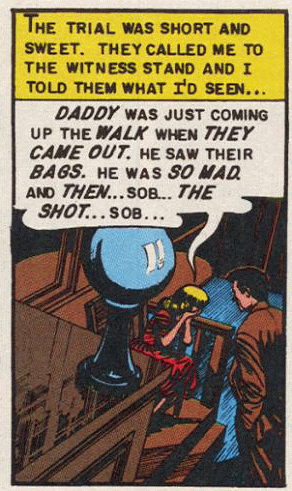

The last two comic books I mentioned are published by the Entertaining Comic group and I mention it because the publisher of Entertaining Comic group will be appearing here later this morning.
Now, that completes the illustration of the type of comics to which we are addressing ourselves.
Mr. BEASER. Just one point, Mr. Clendenen. In talking about the child who is placed in a foster home, turned into a werewolf, you said that psychologically that was disturbing. Why do you say that?
Mr. CLENDENEN. Let me refer back to the time that I was operating an institution for emotionally disturbed children. Any child who is not able to live, continue to live, with his own family and who is disturbed and goes into an institution and then later is facing foster-home placement has a great many fears both conscious and unconscious regarding the future. That is, he is very much afraid, very fearful about going out and living with the family.
He has met them, to be sure, but he does not know them and he is very insecure individual to begin with. This is the type of material that I myself would feel greatly increase a youngster's feeling of insecurity, anxiety, and panic regarding placement in a foster-family home.
Mr. BEASER. Mr. Clendenen, you produced a number of comic books with different titles. Are they all, each one of them, produced by a different company?
Mr. CLENDENEN. No, they are not. The organization of the publishers in the comic-book industry is really a very complex type of organization.
I would like to refer here to the Atlas Publishing Co., or Atlas Publishing group as an example. Atlas represents one of the major publishers in the comic-book field and, incidentally, there will be a representative of the Atlas Co. appearing also at these hearings. The Atlas Co. is owned by a man-and-wife team, Mr. and Mrs. Martin Goodman.
Now the Atlas Publishing Co, Publishes between 49 and 50 different comic titles. However, this number of comic titles, the 45 or 50 comic titles, are produced through no less that some 25 different corporations.
The Atlas organization also includes still another corporation through which it distributes its own publications. This particular exhibit shows 20 of the different groups of crime and weird comics they produce through 15 corporations.
Now, although several of the other publishers who are in the business of publishing comic books are smaller, the patterns of organization are essentially the same.
In other words, many times they organize themselves in forms of 2, 3, 4 or more different corporations. The end result of this type of corporation is that while there are many corporations involved in the publishing of comic books, the entire industry really rests in the hands of relatively few individuals.
Mr. BEASER. When you say they organize into different companies, do they organize into companies that produce nothing but comic books or do they produce other types of literature?
Mr. CLENDENEN. No, they also produce other types of literature. Many of them produce different kinds of magazines in addition to producing comics.
Now, not only may a particular organization be engaged in producing comics, both comic and magazines, but many times they will produce both comics and magazines through one individual corporation within the group.
In this exhibit, for example, this particular comic, which is produced once again by Atlas ─ and we are using Atlas merely as an example ─ these particular publications are not only both produced by the Atlas, but they are produced by a single corporation within the Atlas group.
Mr. BEASER. You say Atlas group. That is a trade-mark?
Mr. CLENDENEN. Yes, all their publications carry the Atlas trademark.
Mr. BEASER. In the course of your investigation has your staff had occasion to review scientific studies which have been made on the effect of crime and horror comics upon children and the relationship to juvenile delinquency?
Mr. CLENDENEN. Yes, we have. This is, we have reviewed virtually all of the surveys and studies that have been made; that is, we have reviewed all that we have been able to find.
I might say that it probably is not too surprising that the expert opinions and findings of these studies are not wholly unanimous. That is, there is certain diversity of opinion regarding the effects of these materials on youngsters even among these individuals whom we might properly qualify as experts.
Now, in this connection, I would like to submit to the subcommittee a few items here which relate to this matter of effects of these materials upon youngsters. One of these is a survey that was made at our request by the Library of Congress which summarizes all of the studies that they could locate having to do with the effects of crime comics upon the behavior of youngsters.
The CHAIRMAN. Is it your desire that this material be put into the record, or made a part of the subcommittees files?
Mr. CLENDENEN. The latter, I believe.
The CHAIRMAN. I think that would be preferable.
Mr. CLENDENEN. I also would like to submit a letter which we received from Dr. Robert Felix, Director of the Institute of Mental Health, to whom we submitted samples of these materials and this is his reply to us indicating his feelings on the effects of these materials.
The CHAIRMAN. Without objection, that will be made a part of the record. Let that be exhibit No. 1.
(The document referred to was marked "Exhibit No. 1," and reads as follows:)
EXHIBIT NO. 1
DEPARTMENT OF HEALTH, EDUCATION, AND WELFARE,
PUBLIC HEALTH SERVICE,
NATIONAL INSTITUTES OF HEALTH,
Bethesda, Md., April 8, 1954.
Mr. RICHARD CLENDENEN,
Executive Director, Subcommittee To Investigate Juvenile Delinquency,
United States Senate, Washington, D.C.
DEAR MR. CLENDENEN: Your letter of march 23, 1954, requested an opinion concerning the effects of comic books upon children. You made it clear that your interest does not really include all comic books, but the rather sensational kinds of which you sent samples.
I think it is fair to say at the outset that there are not many data from experimental sources which answer the question at hand. Let me first cite some rather old analogical evidence. A study was made several years ago on the effects of movies upon the behavior of children and it was concluded that motion pictures have a deleterious influence on 10 percent of males and 25 percent of females. It has also been shown that movie attendance by children results in disturbed sleep, as indicated by increased motility during sleep. This effect sometimes perseveres for 2 or 3 nights. It can therefore be concluded that viewing motion pictures is not neutral event in the case of children. In the absence of similar studies concerning comics, I am included to extrapolate by saying that I believe reading comics may well have similar influences upon children to those that have been demonstrated for the movies.
One can approach this problem also by attempting to indicate what the comics really represent. It is clear that they represent stories about people and their relationships. It is also clear that the relationships are not tranquil, that they are in effect aggressive and hostile. However, children view aggressiveness and hostility in many of their daily experiences, and they themselves show aggressiveness and hostility. The comics of the kinds discussed here are exclusively preoccupied with relationships of this kind, and exclusive reading of the material is therefore a kind of unbalanced intake for a child. It should be noted, however, that all literature, including children's fairy tales, are characterized by treatment of the aggressive and hostile, and that the comics perhaps distinguish themselves only in their rather exclusive interest in situations portraying this kind of behavior.
It has been suggested by some psychiatrists that comic books may have some value in that they represent a sources of fantasy material to the child, and children use fantasy to work out some of their problems and some of their feelings toward other persons. Working out these feelings through fantasy may not be as undesirable as working them out through misbehavior or open acts of impression that there are other ways of working through problems, such as other kinds of reading, play activities with one's peers, activities with adults and the like. It seems preferable that the child at least utilize several of these methods. There probably is some cause for concern if the child devotes himself in a rather excessive manner to comic books as a source of fantasy.
Comic books may well also be significant with respect to psychological difficulties the child already possesses. Hostile feelings towards his parents, for instance, may be brought to the surface through the reading of these books, releasing the children's anxiety, and this result is not desirable. Furthermore, since the violent behavior of the comic books is not limited to the villain of the piece, the child may feel that he secures some sanction from this sources for the open statements can be interpreted as meaning that the pathology of the child is necessarily initiated or caused by the comic book, but that there is a significant relationship between the child's problems and how he reacts to them and the content of these materials. It is perfectly fair to say that this is not always salutory result.
In your letter you ask several specific questions which I shall attempt to give answers. One question deals with the reactions of comic of the disturbed versus the normal child. The emotionally disturbed child may show a greater reaction to comic books of this type than will the normal child. Perhaps it would be better to say that the emotionally disturbed chid may show a greater tendency to read books of this kind than will the normal child. The child with difficulties may find in these books representations of the kinds of problems with which he is dealing, and they will therefore have a value for him which will be nonexistent or minimal in the case of the child who is relatively free of these troubles. In other words, it might be suggested that the kinds of comic books a child chooses could provide to the child psychiatrist some clues with respect to the kinds of problems face by the child.
Your letter also asked about differential effects of the comics upon delinquents and nondelinquents. I doubt that the comic books can be blamed for originating delinquent trends as such in children, bu they might well be instructive in the techniques of delinquency and criminality since they do portray techniques of criminal activity and of the avoidance of detection.
It is not my feeling that the solution to delinquency or emotional disturbances in children is to be found in the banning or elimination of comic books. Rather, I feel that parents do have a responsibility for remaining alert to the kinds of reading material and viewing material, including the comics, being utilized by their children. The wise parent will exercise some discretion and some authoritative control in this connection. The truly wise parent may realize the symptomatic importance of a strong and persistent interest in lurid material and will perhaps seek guidance or therapy for his child. In summary, I should like to add that comics must be viewed as only a part of the total experience of the child and that the same principles of guidance which parents must exercise in all realms of the child’s experience must apply in this area.
The above comments leave many questions unanswered, but I hope that the committee may find this letter of some value in dealing with this difficult problem.
Sincerely yours,
R.H. FELIX, M.D.
Director, National Institute of Mental Health.
Senator KEFAUVER. Does that go for the first memorandum, too? I think the people would like to read the compilation by the Library of Congress.
The CHAIRMAN. Without objection, that will be made a part of the record. Let it be exhibit No. 2.
(The document referred to was marked "Exhibit No. 2," and reads as follows:)
EXHIBIT No. 2
THE LIBRARY OF CONGRESS,
LEGISLATIVE REFERENCE SERVICE,WASHINGTON 25, D. C., MARCH 5, 1954.
CRIME MOVIES, CRIME COMIC BOOKS, AND CRIME RADIO PROGRAMS AS A CAUSE OF CRIME
(Prepared for the use of the Senate Judiciary Committee to investigate juvenile delinquency)
(Note.- This report on the effect of crime comic books, crime movies, and crime radio programs upon delinquency includes quotations from research studies and opinions, as well as critiques of several studies.)
In the past 30 years, from time to time, discussion have arisen, centered around first, crime movies, and in later years the crime radio programs, and more recently crime comic books with respect to their connection with the causation of crime. Opinion have been voiced on this subject by sociologists, criminologists, juvenile court judges, psychiatrists, psychologists, and parents' groups, and in some instances, research studies have been made.
Some authorities feel that a realistic appraisal of these forms of entertainment indicates that, while there are delinquent cases in which they maybe important, on the while their direct influence on the juvenile is either almost nil or serves only to aggravate already existent attitudes and personality traits.1 Herbert Blumer and Phillip Hauser found in their study over 17 years ago that motion pictures were one of the factors that was important in only about 10 percent of the delinquent males and 25 percent of the delinquent girls. 2
Present evidence seems to indicate that the process of acquiring conduct norms, both unconventional and conventional, is primarily through intimate association with others and personal experiences of a face-to-face nature. Delinquents who have already had association through companions with unconventional behavior may be further stimulated by crime motion pictures, by certain radio programs, or by comic books. In a study made of 1,313 gangs in Chicago, Frederic M. Thrasher found that comic strips influenced these groups and their activities. Not only did many of the gangs obtain the names from the comic strip, but suggestions for vandalism and other destructive activities were directly traceable to this source. 3
1. Edwin J. Sutherland. Principles of Criminology, p. 184.
2. Herbert Blumer and Phillip M. Hauser, Movies, Delinquency and Crime, p. 198.
3. Frederic M. Thrasher, The Gang, p. 113.
To date, there have been few truly scientific investigations of the influence of such forms of entertainment on juvenile delinquency. There has been limited investigation of the millions of nondelinquent juveniles who avidly attend crime movies, listen nightly to several radio broadcasts dealing with criminal cases, and read one or two crime comic books a week.
The present report was prepared after a survey of the available materials in the Library of Congress. The basis for choosing articles and studies to be included were the background of the author, his standing and experience in his field of specialty; and in the case of the critiques, the author's recognized authority to judge the studies. This material is presented in chronological order (except where there is a critique of a specific study) with a note about the author, and a statement of the purpose of the study.
HERBERT BLUMER, AND PHILLIP M. HAUSER. Movies, Delinquency, and Crime.
New York: the Macmillan Company. 1933. 233 p. [PN19995.5.B53]
(Herbert Blumer at the time of this study was associate professor of sociology at the
University of Chicago, and Phillip M. Hauser was an instructor in sociology at the same
university.)
The following statement is from the preface of the above book and gives background material on the reason for the study:
"The history of [these] investigations is brief. In 1928 William H. Short, executive director of the Motion Picture Research Council, invited a group of university psychologists, sociologists, and educators to meet with the Members of the Council to confer about the possibility of discovering just what effect motion pictures have upon children a subject * * * upon which many conflicting opinions and few substantial facts were in existence. The university men proposed a program of study. When Mr. Short appealed to the Payne Fund for a grant to support such an investigation, he found the foundation receptive because of its well-known interest in motion pictures as one of the major influences in the lives of modern youth."
The investigation extended over a period of 4 years (1929-32). The purposes was to study the role of motion pictures in the lives of delinquents and criminals of both sexes; and the effects of motion pictures shown to them in prisons and reformatories; and the effect of movies on nondelinquents.
Data was secured by two methods: Questionnaires and autobiographical accounts. The authors give the following "word of caution" at the beginning of their report"
"These statistical data are based on questionnaire tabulations and must be interpreted with great care. They should not be taken as definitely proven measurements of different forms of motion-picture influences but rather as rough approximations suggestive of a likely extent of such influences * * * questionnaire responses are in the nature of opinion and judgement and are subject to the uncertainty and instability which attend such kinds of response." 4
The reader is cautioned to regard the statistical results as "merely distributions of replies roughly suggestive of the extent of different kinds of motion-picture influence." 5
Summary of findings
"* * * motion pictures were a factor of importance in the delinquent of criminal careers of about 10 percent of the male and 25 percent of the female offenders studied * * *. In addition to these readily traced influences, motion pictures or lead individuals to various forms of misconduct.
"Several important indirect influences disposing or leading persons to delinquency or crime are discernible in the experience of male and female offenders. 6
"On the other hand, movies may redirect the behavior of delinquents and criminals along socially acceptable lines and make them hesitant about, and sometimes deter them from, the commission of offenses. 7
"It is evident that motion pictures may exert influences in diametrically opposite directions. The movies may help to dispose or lead persons to delinquency and crime or they may fortify conventional behavior. 8
4. Herbert Blumer and Phillip M. Hauser, op. cit., p.9
5. Ibid., p. 10
6. Ibid., p. 198
7. Ibid., p. 199
8, Ibid., p. 201
"* * * the forms of thought and behavior presented by the movies are such as to provide material and incentive to those sensitized to delinquent and criminal suggestion.
"Motion pictures play an especially important part in the lives of children reared in socially disorganized areas. The influence of motion pictures seems to be proportionate to the weakness of the family, school, church, and neighborhood. Where the institutions which traditionally have transmitted social attitudes and forms of conduct have broken down, as is usually the case in high-rate delinquency areas, motion pictures assume a greater importance as a source of ideas and schemes of life. 9
MORTIMER ADLER. Art and Prudence. New York: Longmans, Green & Co., 1937. 686 pp. [PN1995.5A4]
(The author at the time of writing was associate professor of the philosophy of law
at the University of Chicago.)
Dr. Adler gives the following explanation for writing this book:
"As results of their reading of Crime, Law and Social Science, representatives of the motion picture producers asked me to review for them the recent empirical investigations specifically concerned with the influence of motion pictures on human behavior - to make, in short, a similar analysis of the problems, methods and results of research' 10
He specifically discusses the Blumer and Hauser study in the following statements:
"All through these pages in which case histories are reported, figures cited, and similar may-or-may-not conclusions drawn, there is no recognition on the part of the investigators that they are proceeding without control groups. For all they know, if non-delinquents and non-criminals were made to write their autobiographies under the same type of guidance [as the delinquents], they might find exactly the same kind of items reported as having been impressive in or memorable form the motion pictures they had seen. One would then be entitled to presume that there may be an unconscious connection in their lives between motion pictures and law-abiding behavior, or perhaps the opposite - maybe they were law-abiding in spite of motion pictures.
"Considering the admitted worthlessness of their statistical data and the admitted unreliability of questionnaire responses, how are Blumer and Hauser able to conclude the chapter on female delinquents with the statement: 'It seems clear from the statistical data and from the autobiographical accounts * * * that motion pictures are of importance, both directly and indirectly in contributing to female delinquency.' 11
"As I have said before, research of this sort does not warrant the amount of critical attention I have given it. It could be dismissed in terms of authors' direct or implied admissions of the inadequacy of their method, the unreliability of their raw materials and the insignificance of their numerical data.
"But there are good reasons for exhibiting this piece of research in such a way that all of its defects are plain to anyone. For one thing, the work of Blumer and Hauser has been cited by laymen who are bent upon reform, as a scientific demonstration that the movies are a cause of crime. For another, this type of work is considered creditable by some social scientists." 12
Dr. Adler has the following comment to make about the reliability of scientific research in the study of human behavior:
"Little of what has been accomplished by research in the field of criminology has improved upon the state of common and expert opinion - the "unscientific" opinion of men experienced in dealing with criminals. At best, research has been confirmatory of our doubt about any factor of set of facts as causative of crime.
"In the light of speculative standards, the attempt of scientific investigation in the field of human behavior should always be praised, even when its achievements are of no practical significance. To be practically significant, science must definitely alter the state of existing opinion; but ever when it fails to do this, the same probability is better held as a matter of scientific knowledge than as a matter of opinion. * * * The intrinsic weakness of the study of human behavior as science is further complicated by the methodological incompetence of most of the attempts which have been made." 13
9. Ibid., p. 202
10. Mortimer Alder op. cit., xi.
11. Ibid., p. 280-281.
12. Ibid., p. 255.
13. Ibid., p. 283.
WILLIAM HEALY, and AUGUSTA F. BRONNER. New Light on Delinquency and Its
Treatment. New Haven: Yale University Press. 1936. 226p. [HV9069.H37]
(William Healy, physician and psychologist, was at the time of this study director of
the Judge Baker Guidance Center, Boston, and Augusta Bronner was associated with
him at the center.)
This study presents the results of a research project conducted for the Institute of Human Relations at Yale University. The research was conducted simultaneously in three American cities (Boston, New Haven, and Detroit). Five hundred and seventy-four individuals of one hundred and thirty-three families were studied.
Only brief mention is made of the role of crime motion pictures as an ingredient of delinquent behavior. The authors report that:
"Interest in the movies was exhibited much more by the delinquents than the non-delinquents. Regular attendance once or twice a week was the habit of 88 of the delinquents as against 42 non-delinquents. Only a few delinquents, however, stated that they had derived ideas from gangster or other crime pictures upon with they definitely patterned their own delinquencies." 14
EDWIN H. SUTHERLAND. Principles of Criminology. Philadelphia : J. P. Lippincott Company.
1939. 639 p. [HV6025.S83]
(The author at the time of publication was professor of sociology, Indiana University.)
In the preface Dr. Sutherland says the purpose of this book is "to show some development of criminology toward science." He also states that "A science of criminology is greatly needed at present both for satisfactory understanding and for adequate control. The existing criminology is inadequate: It has consisted of obviously unsound theories of criminal behavior, of scattered and unintegrated factual information, and unwarranted application of that knowledge to practical problems."
Among the other institutions which relate to crime, Dr. Sutherland says:
"The motion pictures are unquestionably an extremely important agency in determining the ideas and behavior of people, and especially of children. * * * In view of this significant effect produced by the pictures on conduct, the content of the pictures is highly important. * * * Children play as gangsters after seeing the pictures and are influenced in other ways. Within a month after "The Wild Boys of the Road" was presented as a motion picture in Evanston, Illinois, during the Christmas holiday of 1933, fourteen children ran away from home. For of these were apprehended by the police and three of the four stated that the freedom depicted in the picture had appealed to them. One of these was a girl fifteen years of age and she was dressed in almost identically the same fashion as the girl who had taken the feminine lead in the picture. 15
"In fact, the general tendency seems to be that the children who reside in areas where delinquency rates are high are influenced more significantly by the crime and sex pictures than are those who live in areas of low delinquency rates. * * * Upon people who already have a fairly stable scheme of life, as adults and as children in good residential areas do, the influence of the motion pictures is less harmful than young people whose habits are less definitely formed and whose environment is more distinctly limited. 16
HOWARD RODLAND. "Radio Crime Dramas". Educational Research Bulletin.
November 15, 1944, pp. 210-217 [L11.E495]
This study analyzes recording made of 20 radio crime dramas.
"By and large, radio crime dramas offer no realistic portrayal of the influences which produce criminals. Only three of the programs based upon the activities of law-enforcement officers made by any attempt to explain the background of the offenders.
* * * There is some evidence that children from delinquent areas listen to crime programs proportionately more than children from nondelinquent areas. This does not mean, however, that listening to crime programs necessarily is a cause of delinquency. Instead, it is more probably that the same economic and cultural factors which produces delinquency also produce a greater number of young people who enjoy crime drama more than other types of programs. 17
14. William Healy, and Augusta Bronner, op. cit., p. 72
15. Edwin H. Sutherland, op. cit., p. 192.
16. Ibid., p. 193.
17. Howard Rowland, op. cit., p. 213.
"Children undoubtedly need a certain amount of excitement and aggression in their drama, but there must be a point beyond which the law of diminishing returns begins to operate. Crime and violence in drama lose their cathartic value when there is a constant habituation to overdoses of these ingredients which not only results in jaded taste in children but may contribute to those frustrations which bring about aggressive behavior. If this premise is correct, it follows that the producers of crime dramas help bring about some of the aggression which these dramas are supposed to relieve." 18
HANS VON HENTIG. CRIME CAUSES AND CONDITIONS. NEW YORK: McGraw-Hill
Book Company, Inc. 1947. 379 p. [HV6025.H45]
(The author at the time of publication was Professor of Criminology at the
University of Kansas City.)
Dr. Von Hentig, in his preface, says:
"Crime, being a pattern of social disorganization, has a multiplicity of causations that rest on defects and obstructions in the working order of society * * *. The statistics that complement personal observations and the lessons to be drawn from the many case studies herein have been brought up to date as of 1940 and 1941.
"* * * In its presentation the book goes it own way. Theoretical views and hypotheses are regularly supported by concrete facts as contributed by judges, district attorneys, police officers, wardens, prison doctors, criminals and victims. * * * Whatever theory is proposed or upheld, it is based on realities and exact observation.
"When movies and radios produce those long-drawn-out slugging scenes in which the hero finally downs the bad man, the G-man, the gangster, or the sheriff, the cattle rustler, we think that the moral outcome should be enough to immunize the aggressive spirit. There will, however, always be some spectators or hearers who are by disposition in a tense readiness for violence, From hearers they turn into doers, today or tomorrow when adequate incentives arise. * * * Some children have an inordinate craving for movies; so have many adults. Burt found this inclination in more than 7 percent of his delinquent boys. 19 The movie has achieved tremendous results in reducing drinking and gambling and thereby cutting down delinquency; yet it may cause misconduct as well.
"There are three sources of possible danger, ably discussed by Burt. While some films do not teach crime, they describe criminal techniques. Before the law starts its triumphal march, wickedness has to be demonstrated; it has to be nearly successful before being smashed. On this phase a good film advertises crime and its technical procedures. 20
JUDITH CRIST. "Horror in the Nursery." Coller's, March 27, 1948. pp. 22-23. [AP2.C65]
(The author quotes extensively from Dr. Frederic Wertham who was formerly the
chief resident psychiatrist at Johns Hopkins University. He was, at the time of the
writing of the article, director of the psychiatric service at Queens General Hospital.)
Dr. Wertham * * * said" "The comic books, in intent and effect, are demoralizing the morals of youth. They are sexually aggressive in an abnormal way. They make violence alluring and cruelty heroic. They are not educational but stultifying."
With 11 other psychiatrists and social works, Dr. Wertham, senior psychiatrist for the New York Department of Hospitals and authority on the causes of crime among children, has spent 2 years studying the effect of comic books on youngsters. His findings [are] published here for the first time. * * *
The purpose of the study was to find "not what harm comic books do," Dr. Wertham said, "but objectively what effect they have on children. So far we have determined that the effect is definitely and completely harmful. * * * We do not maintain that comic books automatically cause delinquency in every child reader. But we find that comic-book reading was a distinct influencing factor in the case of every single delinquent or disturbed child we studied."
Dr. Wertham does not believe that comic books alone can cause a child to become delinquent.
Dr. Wertham feels that a local enforcement of the penal codes by district attorneys, or license commissioners could stop circulation of the most offensive books.
18. Ibid., p. 214.
19. Cyril Burt, The Young Delinquent, D. Appleton-Century Co., Inc., New York, 1925. p. 137.
20. Hans Von Hentg, op. cit., pp. 323-324.
FREDERIC M. THRASHER, "The Comics and Delinquency : Cause or Scapegoat",
The Journal of Educational Sociology, December 1949, pp. 195-205.
(The author at the time of writing this article was a professor at New York
University. He is also an associate editor of the Journal or Educational Sociology and
author of the Gang, a study of 1,313 gangs in Chicago. 1927.)
Dr. Thrasher says that the controversy over motion pictures as a major cause of delinquency closely parallels the present controversy over the role of comic books in the causation of antisocial behavior.
"Delinquent and criminal careers can be understood only in terms of the interaction of many factors. Evaluation of their relative influence demands research based upon more rigorous sampling and control, and requires the utmost objectively in the interpretation of the data the research yields.
"After surveying the studies dealing with the influences of comics we are forced to conclude such research do not exist. The current alarm over the evil effects of the comic books rests upon nothing more than substantial than the opinion and conjecture of a number of psychiatrists, lawyers, and judges.
"Reduced to their simplest terms, these arguments are that since the movies and comics diet is made up of crime, violence, horror, and sex, the children who see the movies and read the comics are necessarily stimulated to the performance of delinquent acts, cruelty, violence, and undesirable sex behavior.
"As an example, let us examine the position of the leading crusader against the comics, New York's psychiatrist Frederic Wertham. [He] disclaims the belief that delinquency can have a single cause and claims to adhere to the concept of multiple and complex causation of delinquent behavior. But in effect his arguments do attribute a large portion of juvenile offenses to the comics. More pointedly he maintains that the comics in a complex maze of other factors are frequently the precipitating cause of delinquency.
"We may criticize Wertham's conclusions on many grounds, but the major weakness of his position is that it is not supported by research data. In Collier's March 27, 1948, his findings are said to be the result of 2 years' study conducted by him and 11 other psychiatrists and social workers at the Lefarge Clinic in New York's Harlem. In this article the claim is made that numerous children both delinquent and nondelinquent, rich and poor were studied and that the results of these studies led to the major conclusion that the effect of comic books is 'definitely and completely harmful'."
Wertham's major claims rest only on a few selected and extreme cases of children's deviate behavior where it is said the comics have played an important role in producing delinquency. Although Wertham has claimed in his various writings that he and his associates have studied thousands of children, normal and deviate, rich and poor, gifted and mediocre, he presents no statistical summary of his investigations. He makes no attempt to substantiate that is illustrative cases are in any way typical of all delinquents who read comics, or that delinquents who do not read the comics do not commit similar types of offenses. He claims to use control groups (nondelinquents), but he does not describe these controls, how they were set up, how they were equated with his experimental groups (delinquents) to assure that the differences in incidence of comic book reading, if any, was due to anything more than a selective process brought about by the particular area in which he was working.
"On the basis of the material presented by Wertham with reference to children's experience with the comics, it is doubtful if he has met the requirements of scientific case study or the criteria for handling life history materials. He does not describe his techniques or show how they were set up so as to safe guard his findings against invalid conclusions. * * * Unless and until Wertham's methods of investigation are described and demonstrated to be valid and reliable, the scientific worker in this field can place no credence in his results.
"In conclusion, it may be said that no acceptable evidence has been produced by Wertham or anyone else for the conclusion that the reading of comic magazines has or has not a significant relation to delinquent behavior."
"LOOKING AT THE COMICS - 1949" (a survey by the children's book committee of the Child
Study Association). Child Study, fall 1949, pp. 110-112.
"In the hope of providing an answer * * * the children's book committee of the Child Study Association some years ago surveyed about a hundred comic magazines and published in Child Study a critique of these for the guidance of parents and others working with children. The enormous growth of these publications in the years since this has prompted a resurvey which reveals some important changes, not only in their quantity but in the kinds of material that are being offered in picture-strip magazines.
"The most regrettable change since the earlier survey has been the increased number of these magazines dealing with 'real' crime, and those featuring sexually suggestive and sadistic pictures. These are presumably not addressed to children ─ are perhaps not even attractive to many of them. Nevertheless, they are available at 10 cents for young people to purchase, and are prominently displayed on newsstands. Some of these are about as uncouth and savage pictures and stories as can be found anywhere."
JOSETTE FRANK. Comics, Radio, Movies ─ and Children. New York: Public Affairs Committee, Inc. (Pamphlet Publication No. 148). 1949. 32 p. [HQ784.A6F7]
(The author is educational associate in charge of children's books and radio on the staff of the Child Study Association of America.)
In discussing crime and the comics, Josette Frank indicates that a number of juvenile court judges have cited the evidence of children brought before them who declared that they had "done it because they read it in the comics." Such evidence is discounted by others ─ criminologists and psychologists ─ who point out that children in trouble can hardly be expected to understand their own behavior, much less explain it. The causes of behavior, they insist, are deep and complex. "In studying the causes of behavior problems of children for many years," wrote Dr. Mandel Sherman, professor of educational psychology at the University of Chicago, "I have never seen one instance of a child whose behavior disturbance originated in the reading of comic books, nor even a case of a delinquent whose behavior was exaggerated by such readings. A child may ascribe his behavior to a comic he has read or a movie he has seen. But such explanations cannot be considered scientific evidence of causation." 21
21 Josette Frank, op. cit., p. 7.
CAVANAGH, JOHN R. The Comics War. The Journal of Criminal Law and Criminology (Northwestern University School of Law) volume XL, June 1949.
(Dr. Cavanagh is the senior medical officer and psychiatrist, United States naval disciplinary barracks, Portsmouth, N. H.).
"Little factual evidence has been produced that the comics are harmful. A small number of cases have been produced in which comic-book reading has preceded or accompanied the commission of a crime. Actually does this prove anything? * * * If it is true as we are told, that 40 million comic books circulate each month and that each one has several readers, should not their harmful effects, if any, be more evident? Emotionalism sells better than intellectualism, and makes better copy.
* * * * * *
"If the comics are as bad as we hear they are, something should be done about them. What we need, however, are fewer exclamations and more facts. Up to the present there have been more references to the harmful effects of the comics in the popular press than in the professional literature. * * * My plea is to investigate first why children like comics and secondly to determine, if possible, how harmful they really are.
* * * * * *
"* * * the normal aggressive reactions find release In the phantasies stimulated by the comic books which thus become the means by which children are able to work off their hostility toward their parents and others without the development of guilt which they might otherwise feel. They may thus displace onto the characters in the comic books the aggression which would otherwise be too dangerous to show overtly or even to imagine. Many have commented on the quieting effect of the comics, the "marijuana of the nursery," usually in the belief that this is harmful. It seems more likely that the child is merely projecting himself into the story and releasing his aggression in the realm of phantasy rather than finding it necessary to be noisy, troublesome, or to indulge in other overt aggressive behavior. For the normal child such conduct is not harmful or detrimental. For the neurotic child it could be detrimental but not necessarily so, and in any case he will be equally harmed by radio or movies.
* * * * * *
"The prevalent attitude seems to be that all comics are objectionable This is certainly not the case, and if you read the 'fine print' almost everyone who writes about the comics admits this. Unfortunately, the average reader is not concerned with the ordinary work-a-day writings. His attention must be caught and retained. * * * in order to retain an audience it is necessary to highlight the unusual, the bizarre, the sensuous, the anxiety-producing factors. The facts are there, but the usual, the ordinary have slight sales value and consequently must be softened in the interest of the stimulating, unusual items.
"There are comics which are undesirable. These are in the minority. The group known collectively as 'jungle adventure comics,' typify this class. Within the group all of the features are displayed which have been considered objectionable. Here are found the scantily clad females, the chained females, and the sexually suggestive situations Which are the comics' most objectionable feature. However, such pictures and situations become significant principally when viewed through the repressions of the viewer and seem to arouse little anxiety in the well-adjusted reader.
NEW YORK STATE JOINT LEGISLATIVE COMMITTEE TO STUDY THE PUBLICATION OF
COMICS, formed in 1949.
The committee reported in 1951 the following findings, which are condensed:
"1. The entire comic-book industry is remiss in its failure to institute effective measures to police and restrain the undesirable minority of stubborn, willful, irresponsible publishers of comics whose brazen disregard for anything but their profits is responsible for the bad reputation of the publishers of all comics.
"2. Comics are a most effective medium for the dissemination of ideas and when such a medium is used to disseminate bad ideas which may leave deep impressions on the keen absorptive minds of children, the unrestricted publication and distribution of comics becomes a matter of grave public concern.
"3. Comics which depict crime, brutality, horror, and which produce race hatred impair the ethical development of children, describe how to make weapons and how to inflict injuries with these weapons, and how to commit crimes have a wide circulation among children.
"4. The New York State Joint Legislative Committee states flatly as follows:
Crime comics are a contributing factor leading to juvenile delinquency.
"5. Instead of reforming, publishers of bad crime comics have banded together, employed resourceful legal and public-relations counsel, and so-called educators, and experts in a deliberate effort to continue such harmful practices and to fight any and every effort to arrest or control such practices.
"6. The reading of crime comics stimulates sadistic and masochistic attitudes and interferes with the normal development of sexual habits in children and produces abnormal sexual tendencies in adolescents.
"A disturbing feature of this situation is that publishers of completely wholesome and acceptable comics have come out squarely in support of publishers of the objectionable type, even though the latter are making serious competitive inroads in their field. One reason given is that all publishers, both good and bad, fear any governmental imposition of regulation and possible censorship of their publications."
The New York State committee grouped objectionable comic books under these descriptions:
1. Those which depict brutality, violence, and crime.
2. Those which depict ways of inflicting bodily injury, plans for commission of crime, and unlawful breakings.
3. Those which are sexually suggested and in some instances depict semihidden
pornography.
The New York committee concluded that governmental regulation should be undertaken as a last resort and only after the industry itself has shown an inability or incapacity to do it, or has failed or refused to do it.' 22
22 U. S. Congress. House Select Committee on Current Pornographic Materials. Report
pursuant to H. Res. 596. Washington, U. S. Government Printing Office, 1952, pp. 27─28
(82d Cong., 2d sess., H. Rept. No. 2510).
MALTER, MORTON The content of current comic magazines. Elementary school journal (Chicago) v. 52, May 1952: 505─510.
(Dr. Malter is assistant professor of education at Michigan State College, East Lansing).
"The major purpose of this study is to determine whether or not this impression is valid. This is accomplished through an analysis of the comic magazines. proffered by the publishers during the 2-month period in 1951."
Mr. Malter wrote to the 22 comic-book publishers listed In the 1950 edition of N. W. Ayer & Son's Directory of Newspapers and Periodicals. In return he received 185 comic magazines from 17 of these publishers. One published no longer put out comic books and four publishers did not answer his request.
Two of his conclusions follow:
"1. Various writers have maintained that crime stories dominate the comic magazines, while humorous content is restricted. The results of this study indicate that this criticism is not valid. Rather, the data suggests (a) that the percents of pages devoted to humor and crime are approximately equal and (b) that approximately one-third of all comic-story content is devoted to humor.
"2. The writer concludes that general attacks on the comic magazines are unwarranted. Unquestionably, It is desirable for persons to graduate from reading comic magazines to the reading of more sophisticated material. However, it seems unreasonable to blanket all comic magazines under the heading unacceptable"; for, as in all other areas, good and bad examples are to be found. In attempting to improve reading habits, It seems desirable (a) to eliminate unacceptable comic magazines by teaching children to be selective in their reading and (b) to make available to readers other books within their experiences.
WILLIAM W. BRICKMAN. Causes and cures of juvenile delinquency. School and society (New York) v. 75, June 28, 1952, p. 410.
(Dr. Brickman is professor of education at New York University and the editor of School and Society Magazine).
"As one reads the professional literature and the lay expressions of opinion about juvenile delinquency, one becomes aware of differences of emphasis and of opinion regarding causes, treatments, cures, and preventive work. There are those who put their eggs in the basket of comic books, television programs, narcotics, or other features of our society. While a trend is in the making along the lines of multiple causation and therapeutics, there does not exist sufficient recognition of it in public circles. Some still snipe at the old-fashioned school for its supposed role in the making of delinquents, while others are equally unreasonable in attributing all behavioral ills to progressive education."
LEVERETT, GLEASON. In defense of comic books. Today's health (Chicago) v. 30,
Sept. 1952: 40─41.
(Mr. Leverett is the former president, Association of Comics Magazine Publishers).
"Well over 75 percent of all children between 4 and 19 are regular readers of comics magazines. Sales total between 60 and 70 million copies a month. More than 400 different comics magazines are on sale today. They constitute more than a third of all the newsstand reading matter in this country. The influence that this part of the reading diet has en children has become an important consideration for parents, educators, sociologists, doctors and, in fact, the entire population.
* * * * * * *
"The effect of brutality, sex, sadism, and cruelty in children's reading matter is self-evident. No comic book which includes such matter can ever be acceptable. The strict code of ethics set up by the Association of Comics Magazine Publishers has brought about the elimination of such scenes from the magazines published by association members. Every issue of the magazines put out by members is examined before it is printed by an arbiter retained by the association.
LEWIN, HERBERT S. Facts and fears about the comics. Nation's Schools (Chicago). v. 52, July 1953: 46─48.
(Mr. Lewin is a clinical and child psychologist in New York City.)
"Governors, legislators, parents, and professional educators find themselves In a still growing debate over the reputed psychological menace to millions of children, a threat that sems to lurk between the covers of many comic books.
"Some zealous experts demand that these booklets be outlawed. Considering the widespread demand for the controversial comics, such a move might well result in a new source of revenue for enterprising citizens interested in bootlegging or blackmarketing the 'hot goods.'"
* * * * * * *
"Before discussing our belief that the harmful influence of the comics has been overrated, let us give some attention to the thinking that has led to objections to them. Many persons concerned with juvenile delinquency and problems of mental hygiene believe that there is a direct relationship between the reading of undesirable literature and improper behavior. They argue that juvenile delinquency frequently occurs alongside of excessive comic-book reading. They feel that the continuous stress on the excitement and glamor of crime might poison the thoughts and emotions of children, and, in certain cases, might cause them to become delinquents"
* * * * * * *
"The danger seems to be great, it is of crucial importance to find out whether comic-book reading really has the feared due outcome.
"To answer the questions as to whether the reading of comics actually results in antisocial behavior, the following experiment was made recently. Nearly 260 city boys of average intelligence and between the ages of 12 and 13 were closely investigated as to their reading habits and interests."
* * * * * * *
"Apparently comic-book reading in itself is not the cause of maladjustment and similar studies with respect to the effects of radio and television programs confirm the findings. * * *
"One thing seems to be certain: Excessive comic-book reading can be a symptom of maladjustment but it is rarely, if ever, its cause. For example, a habitual young thief has been found to be an ardent comic-book reader. Has this reading caused him to become a thief? Scarcely. We feel safe to say that his reading is a symptom of a long-standing personality problem but not the cause of his delinquency. This is true just as we know now that alcoholism is a symptom of an emotional disturbance but not its cause."
* * * * * * *
"We must attack delinquency and emotional disturbances at their roots. Yet we cannot overlook the fact that occasionally comics may be the vehicles of maladjustment. We can change the character of many comic books in a wholesome fashion; at the same time we do not have to remove from the books much that makes them attractive to our youth."
* * * * * * *
"Many comic-book stories, too, contain an extremely harsh and punitive view with respect to their villains. * * * Frequently no motives for their acts are given but the basest and rudest ones. Stories of this kind do not frighten a potential delinquent. However, they can unnecessarily increase the anxiety of young people who are worried about their minor misdeeds. Moreover, such stories tend to blunt the sense of justice and the spirit of forgiveness and thus they play the game of authoritarian philosophers."
* * * * * * *
"Comics have many faults but their damaging influence has been overrated. Official prohibition will not solve the problem because legislation would be virtually unenforceable it would encourage illegal distribution and put a premium on reading the least desirable strips just because they are 'forbidden fruit.' Neither will censorship improve the state of affairs, quite apart from the undesirability of all legal intervention in the field of literature. Only public pressure on comic-book publishers and editors will bring about a change for the better. Parents, teachers, ministers, child-welfare workers, and psychologists could successfully exert this pressure."
N. E. A. Research Bulletin. Schools help prevent delinquency (Wash.) v. 31.
Oct. 1953. P. 107─108
"From time to time crime depicted in comic books as well as on radio and television programs has been charged with directly contributing to juvenile delinquency. Conclusive evidence on the subject is not available. Reputable authorities are lined up on both sides of the question.
"The number of comic books in circulation in recent years has skyrocketed as compared with about 10 million copies a month in the last 3 prewar years, the 1947 rate was 60 million copies a month. An estimated 40 percent of the purchasers are young folks between the ages of 8 and 18. No estimate is readily available of the number of comic books concerned with sadistic
crime and horror stories.
"Other mass mediums of communication also offer a strong diet of violence. On the four major radio networks, programs that embodied violence or threat of violence were transmitted for a total or more than 85 separate time periods in 1 week (1950). Television has a similar record. On 7 stations in the New York area the listener had the pick of more than 75 periods a week when a taste of life outside the law could be had.
No acceptable evidence to date has shown these factors to have a significant relation to delinquent behavior. To be sure, in isolated instances judges have reported commissions of youth where comic books have been named as the source of the idea. But upon further investigation such youngsters were found to need help beside and beyond scrutiny of their reading and listening habits.
"The foregoing statements do not condone the cultivation of low tastes nor condemn the legitimate realization that some persons gain from an occasional detective story. Regardless of such considerations, the development of good communication tastes is an educational goal that can stand on its own merits."
WERTHAM, FREDERIC. What parents don't know about comic books. Ladies home journal (Philadelphia) Nov. 1958.
(Dr. Wertham is a psychiatrist and in this article refers to his research work at the Lafargue Psychiatric Clinic in New York City and the Queens Mental Hygiene Clinic.)
In this article the author presents vivid illustrations from many crime comic books being read by children and adults. He contends that:
"Juvenile delinquency is not just a prank, nor an emotional illness. The modern and more serious forms of delinquency involve knowledge of techniques. By teaching the technique, comic books also teach the content."
* * * * * * *
"What is the relationship of crime-comic books to juvenile delinquency? If they would prevent juvenile delinquency there would be very little of it left. And if they were the outlet for children's primitive aggressions, this would be a generation of very subdued and controlled children. After all, at times the output of comic books has reached 950 million a year, most of them dealing with crime. The whole publicity-stunt claim that crime comics prevent juvenile delinquency is a hoax. I have not seen a single crime-comic book that would have any such effect. Nor have I ever seen a child or young adult who felt that he had been prevented from anything wrong by a comic book. * * *
"The role of comic books in delinquency is not the whole nor by any means the worst harm they do to children. It is just one part of it. Many children who never become delinquent or conspicuously disturbed have been adversely affected by them.
"My investigations and those of my associates have led us, very unexpectedly at first, but conclusively as the studies went on, to the conclusion that crime comics are an important contributing factor to present-day juvenile delinquency. Not only are crime comics a contributing factor to many delinquent acts, but the type of juvenile delinquency of our time cannot be understood unless you know what has been put into the minds of these children. It certainly is not the only factor, nor in many cases is it even the most important one; but there can be no doubt that it is the most unnecessary and least excusable one."
Dr. Wertham also discusses the elusiveness of some comic-book publishers who go out of business under one name and reappear as new publishing firms. He says, "This is why I have called crime-comic books 'hit-and-run publications.'"
"Crime comics create a mental atmosphere of deceit, trickery, and cruelty. Many of the children I have studied have come to grief over it. How best to summarize the attitudes most widely played up in crime comics? One might list them in some such way as this: assertiveness, defiance, hostility, desire to destroy or hurt, search for risk and excitement, aggressiveness, destructiveness, sadism, suspiciousness, adventurousness, nonsubmission to authority. Anybody could make up such a list by going over a thousand comic books. Actually, though, this is a literal summary of the traits of typical delinquents found by the famous criminologists Sheldon and Eleanor Glueck in a study of 500 delinquents when compared with 500 nondelinquents. In other words, the very traits that we officially wish to avoid we unofficially inculcate."
* * * * * * *
“Legal control of comic books for children is necessary not so much on account of the question of sex, although their sexual abnormality is bad enough, but on account of their glorification of violence and crime. In my attempts to formulate the principles of a crime-comic-book law I realized that it is necessary to introduce more public-health thinking for the protection of children's mental health. * * *
"Laws in the service of public health do not necessarily deal with criminal intent. They cope with what the lawyers call public-welfare offenses dealing with food, drugs, and sanitation. What I wanted to accomplish was to add mental health to these categories."
* * * * * * *
"I have seen many juvenile delinquents who were predisposed to achieving good things in life and were deflected from their course by the social environment of which comic books are a part. We would not by law permit people to sell bad candy with poisonous ingredients because the manufacturer guarantees that it will not hurt children with strong stomachs and will sicken only those children who are inclined to have stomach upsets in the first place. In public health we also have little sympathy with the claim that we don't have to prevent illness because if we rule out one factor people would get sick sooner or later anyhow, if not with this disease, then with something else. Yet that is how the comic-book industry reasons."
SOLOMON, BEN. Why we have not solved the delinquency problem. Federal probation (Washington) v. 27, Dec. 1958: 11─19.
(Mr. Solomon is editor of Youth Leaders Digest, Putnam Valley, N. V.)
This writer contends that the only way to solve the delinquency problem among youngsters is through prevention. He also holds that there are nine "fallacies" which are generally believed by persons who are concerned over the problem.
He has this to say about fallacy No. 2:
"Comics create crime. It is common practice to blame the comics, TV, the radio, and movies for much of our delinquency. It is pointed out that some youngsters are highly 'suggestible' and that through these media they might learn the methods of crime and how to skillfully avoid detection. Maybe so, but I'd like to point out that all children listen to the radio, see TV, and the movies, and read the comics, and that 99 percent of them don't get into any kind of trouble. And it might further be pointed out that we've had lots of delinquency long before these things came into being."
Mr. CLENDENEN. I also have a compendium of the Journal of Educational Sociology which shows the result of comics on delinquency by Dr. Thrasher, who is a noted criminologist connected with the University of Chicago.
The CHAIRMAN. Without objection, that will be made a part of the record. Let that be exhibit No. 3.
(The article referred to was marked "Exhibit No. 3," and reads as follows:)
EXHIBIT NO. 3
THE COMICS AND DELINQUENCY: CAUSE OR SCAPEGOAT
Frederic M. Thrasher
Expert students of mankind have always tried to explain human behavior in terms of their own specialities. This is particularly true in the field of adult and juvenile delinquency, where anthropologists, psychologists, psychiatrists, and sociologists have been guilty of a long series of erroneous attempts to attribute crime and delinquency to some one human trait or environmental condition. These monistic theories of delinquency causation illustrate a particularistic fallacy which stems from professional bias or a lack of scientific logic and research, or both.
Most recent error of this type is that if psychiatrist Fredric Wertham who claims in effect that the comics are an important factor in causing juvenile delinquency. 1 This extreme position which is not substantiated by any valid research, is not only contrary to considerable current psychiatric thinking, but also disregards tested research procedures which have discredited numerous previous monistic theories of delinquency causation. Wertham's dark picture of the influence of comics is more forensic than it is scientific and illustrates a dangerous habit of projecting our social frustrations upon some specific trait of our culture, which becomes a sort of "whipping boy" for our failure to control the whole gamut of social breakdown. 2
1 Wertham, Who is a prominent New York psychiatrist, has stated his position on the comics in the following articles: The Comics─Very Funny, Saturday Review of Literature, May 29, 1948; What Your Children Think of You, This Week, Oct. 10, 1948; Are Comic Books Harmful to Children?, Friends Intelligencer, July 10, 1948; the Betrayal of Childhood: Comic Books, Proceedings of the Annual Conference of Correction, American Prison Association, 1948; the Psychopathology of Comic Books (a symposium), American Journal of Psychotherapy July 1948; and What Are Comic Books? (a study course for Parents), National Parent Teacher Magazine, March 1949.
2 Cf. Katherine Clifford, Common Sense About Comics, Parents Magazine, October 1948.
One of the earliest of these monistic errors was that of Lombroso and his followers of the so-called Italian School of Criminology, 3 who asserted there was a born criminal type with certain "stigmata of degeneracy" which enabled the criminal to be distinguished from normal people. These included such characteristics as a cleft palate, a low retreating forehead, a peculiarly shaped head, nose, or jaw, large protruding ears, low sensitivity to pain, lack of beard in males, obtuseness of the senses, etc. These "criminal traits" were explained as due to a reversion to a hypothetical "savage" (atavism), or to physical and nervous deterioration. Accompanying the physical divergencies in some unexplained manner always went a predisposition to delinquency. Exponents of this theory in its extreme form have even claimed that different types of criminals exhibit different sets of physical anomalies.
3. Lombroso first stated his theory in a brochure in 1876 and this was expanded later into three volumes. See Cesare Lombroso, Crime: Its Causes and Remedies. Translated by H. P. Horton. Boston: Little, Brown, 1918.
More rigorous investigators shortly discredited this naive theory. One of these was England's distinguished Charles Goring. He rejected Loinbroso's conclusion because it was based upon an inadequate sample of the criminal population, chiefly the inmates of an institution for the criminally insane. As Von Hentig Succinctly points out, only "minute sections of crime are found in court or in prison, a certain proportion in institutions for the criminally insane. Crime's most numerous and dangerous representatives are never seen by a judge, a warden, or a psychiatrist."4 No valid conclusion concerning delinquents and criminals as a whole can be drawn from the small proportion of their number appearing in clinics or found in institutions.
4. Hans Von Hentig, Crime: Causes and Conditions. New York: McGraw Hill, 1947.
Goring rejected Lombroso's theory further, and more importantly, because it ignored the possibility that the traits to which delinquent and criminal behavior were attributed might be as prevalent among law-abiding citizens. Goring was an exponent of the elementary scientific technique which insists on the use of a control group, a simple yet essential statistical maneuver designed to protect the scholar and the public against fallacious conclusions about human behavior. The use of the control group as applied to the study of the causation of delinquency simply means that the investigator must make sure the trait or condition to which he ascribes delinquency is not as prevalent among nondelinquents as among delinquents.
When Goring studied not merely the inmates of prisons, but a representative sampling of the unincarcerated population, he found "stigmata" to occur no more frequently among prisoners than among people at large. 5 Lombroso's theory was knocked into a cocked hat.
5. Charles Goring, the English Convict. London: Stationery Office, 1918.
Students of delinquent and criminal behavior were slow, however, to heed the lesson implicit in the collapse of Lombroso's theory. Continuing to seek a simple monistic explanation of antisocial behavior, repeating Lombroso's errors of inadequate sampling and lack of control, they have attributed the bulk of delinquency to mental deficiency, to focal infections, to lesions of the nervous system, to psychopathic personality, to poverty, to broken homes, to one after another of the characteristics of the delinquent or his environment.
More rigorous sampling and control have forced the abandonment of these one-sided explanations. The assertion of Tredgold and Goddard, 6 for example that mental deficiency is the major cause of antisocial behavior was based on institutional samples of the delinquent population. It should be reiterated that such samples are highly selective, since more intelligent criminals are less frequently found in institutions or other groups available for testing. Indeed adequately controlled studies, such as those of Carl Murchison, 7 E. A. Doll 8 and Simon H. Tulchin 9 have conclusively shown that low intelligence of itself is not an important factor in producing delinquency.
6. A. F. Tredgold, Mental Deficiency, New York: William Wood, 1914; and Henry H. Goddard, Feeblemindedness: Its Causes and Consequences. New York: Macmillan, 1914.
7. American White Criminal Intelligence, Journal of Criminal Law and Criminology, August and November 1924.
8. The Comparative Intelligence of Prisoners, Journal of Criminal Law and Criminology, August 1920.
9. Simon H. Tulchin, Intelligence and Crime. Chicago: University of Chicago Press, 1939.
Sociological studies have shown marked correlations between poverty and delinquency. But again the sample is selective, biased by the fact that official statistics fail to record the large number of delinquencies committed in more prosperous sections of time community; and again one is given pause by the necessity of accounting for the large numbers of children in the most dire economic need who do not become delinquent. As for broken homes, the studies of Slawson 10 in New York, and of Shaw and McKay 11 in Chicago, have shown that time broken home in itself cannot be considered a very significant factor in explaining delinquency.
10. John Slawson, the Delinquent Boy. Boston: Badger, 1926.
11. Clifford R. Shaw and Henry D. McKay, Social Factors in Juvenile Delinquency. Washington: Government Printing Office, 1931, pp. 261─284.
More recently it has been asserted that motion pictures are a major cause of delinquency. The controversy over the truth of this assertion closely parallels the present controversy over the role of comic books in the causation of anti-social behavior. The Motion Picture Research Council, with the aid of a research grant from the Payne Fund, and in cooperation with a number of universities, undertook a series of objective studies of time question.12
12. For a history of this controversy, the results of the Payne Fund Studies, and a critical evaluation of them, see: Henry James Furman, Our Movie Made Children, New York, Macmillan, 1933; Martin Quigley, Decency in Motion Pictures, New York, Macmillan, 1935; Frederic H. Thrasher, Education Versus Censorship, Journal of Educational Sociology, January 1940; W. W. Charters, Motion Pictures and Youth : A Summary, New York, Macmillan, 1933; Mortimer J. Adler, Art and Prudence, New York, Longman's Greene, 1937.
The most conclusive of these studies as it bears upon the relationship of the motion picture to the causation of delinquency, was conducted at New York University by Paul G. Cressey.13 Cressey's findings, based upon thousands of observations under controlled conditions, showed that the movies did not have any significant effect in producing delinquency in the crime-breeding area in which the study was made. Cressey readily admits that boys and young men, when suitably predisposed, sometimes have utilized techniques of crime seen in the movies, have used gangster films to stimulate susceptible ones toward crime, and on occasion in their own criminal actions have idealized themselves imaginatively as possessing as attractive a personality, or as engaging in as romantic activities as gangster screen heroes.14 Cressey is careful to follow this statement, however, with the explanation that he does not mean that movies have been shown to be a "cause" of crime, that he does not mean that "good" boys are enticed into crime by gangster films, that he merely means what he has said that boys and young men responsive to crime portrayals have been found on occasion to use ideas and techniques seen at the movies. This type of analytical thinking is largely absent from the findings of such critics of the comics as Fredric Wertham.
13. Paul G. Cressey, The Role of the Motion Picture in an Interstitial Area. (Unpublished manuscript on deposit in the New York University library.)
14. Paul G. Cressey, The Motion Picture Experience as Modified by Social Background and Personality, American Sociological Review, August 1938, p. 517.
Furthermore Cressey found that urban patterns of vice, gambling, racketeering, and gangsterism, including large components of violence, were so familiar to the children of this district that movies seemed rather tame by comparison. That this section of New York is typical of the thousands of other delinquency areas in American cities cannot be doubted.15 It is from these areas that the large proportion of official juvenile delinquents come and there is no reason to doubt that the role of the motion picture in producing delinquency is any greater in these areas in other American cities than it was found to he in New York.
15. See Clifford R. Shaw and Henry U. McKay, Report on Social Factors in Juvenile Delinquency, National Commission on Law Observance and Enforcement (No. 18, vol. II), Washington: Government Printing Office; ─, Delinquency Areas. Chicago: University of Chicago Press, 1929; and---, Juvenile Delinquency and Urban Areas, Chicago: University of Chicago Press, 1942.
The behavior scientist has learned that the causes of antisocial behavior─like the causes of all behavior─are complex. Delinquent and criminal careers can be understood only in terms of the interaction of many factors. Evaluation of their relative influence demands research based upon the most rigorous sampling and control, and requires the utmost objectivity in the interpretation of the data the research yields.
Let us now turn to researches dealing with the influence of comics. After surveying the literature we are forced to conclude such researches do not exist." The current alarm over 'the evil effects of comic books rests upon nothing more substantial than the opinion and conjecture of a number of psychiatrists, lawyers and judges. True, there is a large broadside of criticism from parents who resent the comics in one way or another or whose adult tastes are offended by comics stories and the ways in which they are presented. These are the same types of parents who were once offended by the dime novel, and later by the movies and the radio. Each of these scapegoats for parental and community failures to educate and socialize children has in turn given way to another as reformers have had their interest diverted to new fields in the face of facts that could not be gainsaid.
16. There is the possible exception of the study of Katherine M. Wolfe and Marjorie Fiske at Columbia University. The Children Talk A bout Comics, published by Paul F. Lazarsfeld and Frank Stanton, Communications Research, 1948─49, New York: Harper, 1949. This study, which was based on a small number of cases, was inconclusive.
As an example, let us examine the position of the leading crusader against the comics, New York's psychiatrist Fredric Wertham.17 Wertham's attitude and arguments in condemning the comics are very similar to those of the earlier critics of the movies. Reduced to their simplest terms, these arguments are that since the movies and comics are enjoyed by a very large number of children, and since a large component of their movie and comics diet is made up of crime, violence, horror, and sex, the children who see the movies and read the comics are necessarily stimulated to the performance of delinquent acts, cruelty, violence, and, undesirable sex behavior. This of course is the same type of argument that has been one of the major fallacies of all our monistic errors in attempting to explain crime and delinquency in the past.
17. Wertham's position was stated in some detail in an article by Judith Crist, Horror in the Nursery, Collier's, March 27, 1948. See also material by Wertham cited earlier in this article.
Wertham's reasoning is a bit more complicated and pretentious. His disclaims the belief that delinquency can have a single cause and claims to adhere to the concept of multiple and complex causation of delinquent behavior. But in effect his arguments do attribute a large portion of juvenile offenses to the comics. More pointedly he maintains that the comics in a complex maze of other factors are frequently the precipitating cause of delinquency.
We may criticize Wertham's conclusions on many grounds, but the major weakness of his position is that it is not supported by research data. His findings presented for the first time in Collier's magazine 18 are said to be the result of 2 years' study conducted by him and 11 other psychiatrists and social workers at the Lafargue Clinic in New York's Negro Harlem. In this article the claim is made that numerous children both delinquent and nondelinquent, rich and poor, were studied and that the results of these studies led to the major conclusion that the effect of comic books is "definitely and completely harmful."
18. Loc. cit., pp. 22, 28, 95─97.
That Wertham's approach to his problem is forensic rather than scientific is illustrated by the way in which his findings are presented in the Collier's article. Countering his claim that the effect of comics is definitely and completely harmful are statements in this article that comics do not automatically cause delinquency in every reader, that comic books alone cannot cause a child to become delinquent, that there are books of well-known comics which "make life better by making it merrier" and others "which make it clear even to the dullest mind, that crime never pays," and that there are "seemingly harmless comic books," but "nobody knows with any degree of exactness what their percentage is.”
A further illustration of this forensic technique is the way in which he introduces extraneous facts and statements which by implication he links with his thesis that the comics are a major factor in causing delinquency and emotional disturbance in children. An example is New York's Deputy Police Commissioner Nolan's statement that "the antisocial acts of the juvenile delinquents of today are in many instances more serious and even of a more violent nature than those committed by youth in the past." Even if this statement could be proved, there is not the slightest evidence, except Wertham's unsupported opinion, that the increase is due to the reading of comic books. Wertham then cites a series of sensational child crimes headlined in the press (not his own cases), which he imputes to the comics without any evidence at all that the juvenile offenders involved ever read or were interested in comic books. A final example of the improper use of extraneous material is the statement in the Collier's article that "Children’s Court records show that delinquent youngsters are almost 5 years retarded in reading ability," and Wertham is quoted as saying that "children who don't read well tend to delinquency." These statements are
unsupported, but even if true, there is not a scintilla of evidence that the reading retardation or disabi1ity of delinquents is due to reading comics. It is quite likely that the percentage of reading disability among delinquents was equally high or higher before the comic book was invented. As a matter of fact there are in this article no data which could be accepted by any person trained in research without documentation.
Wertham asserts that the content of the comics is almost universally one of crime, violence, horror, "emphasis of sexual characteristics" which "can lead to erotic fixations of all kinds," and "sadistic-masochistic mixture of pleasure and violence." Of the millions of comic books which Wertham claims deal with crime and brutality, he is content to rest his case on the selection of a few extreme and offensive examples which he makes no attempt to prove are typical. No systematic inventory of comic book content is presented, such as that compiled by Edgar Dale for the movies in 1935. 19 Without such an inventory these conjectures are prejudiced and worthless.
19. Edgar Dale, The Content of Motion Pictures, New York: Macmillan, 1933.
Wertham's major claims rest only on a few selected and extreme cases of children’s deviate behavior where it is said the comics have played an important role in producing delinquency. Although Wertham has claimed in his various writing that he and his associates' have studied thousands of children, normal and deviate, rich and poor, gifted and mediocre, he presents no statistical summary of his investigations. He makes no attempt to substantiate that his illustrative cases are in any way typical of all delinquents who read comics, or that the delinquents who do not read the comics do not commit similar types of offenses. He claims to use control groups (nondelinquents) but he does not describe these controls, how they were set up, how they were equated with his experimental groups (delinquents) to assure that the difference in incidence of comic-book reading, if any, was due to anything more than a selective process brought about by the particular area in which be was working.
The way in which Wertham and his associates studied his cases is also open to question. The development of case studies as scientific data is a highly technical procedure and is based on long experience among social scientists in anthropology, psychology, and sociology. 20 An adequate case study, which involves much more than a few interviews, gives a complete perspective of the subject's biological, psychological, and social development, for only in this manner can a single factor such as comic-book reading be put in its proper place in the interacting complex of behavior-determining factors. 21 On the basis of the materials presented by Wertham with reference to children's experience with the comics, it is doubtful if he has met the requirements of scientific case study or the criteria for handling life history materials. He does not describe his techniques or show how they were set up so as to safeguard his findings against invalid conclusions.
20. See Paul Horst et al., The Prediction of Personal Adjustment. New York: Social Science Research Conncil, 1941 especially The Prediction of Individual Behavior From Case Studies, pp. 183─249; Gordon W. Allport, The Use of Personal Documents in Psychological Science, New York: Social Science Research Council 1942; and Louis Gottschalk, Clyde Kluckholm and Robert Angell, The Use of Personal documents in History Anthropology and Sociology. New York: Social Science Research Council. 1945.
21. Examples of case studies are to be found in the earlier studies of William Healy end Augusta F. Bronner in Case Studies, Series I. Nos. 1─20, Boston; Judge Baker Foundation, 1923, and in the more complete Studies of Clifford R. Shaw et al., The Jackroller, The Natural History of a Delinquent Career, and Brothers in Crime. Chicago: University of Chicago. 1930, 1931, and 1938
Were the subjects he interviewed studied with the same meticulous care employed by a Healy or a Shaw? Did he get complete data on them? Were the circumstances surrounding the interviews such that the subjects gave honest answers to the questions asked by Wertham and his associates? Were safeguards set up to control individual differences in the interview techniques of the eleven different investigators? Even if it is assumed that such subjects will or can give a correct picture of the role of the comics in their lives, how are we to be sure that the interviewers' did not ask leading questions and stimulate the responses of the subjects to reply along a preordained line of thinking or imagining? Unless and until Wertham's methods of investigation are described, and demonstrated to be valid and reliable, the scientific worker in this field can place no credence in his results.
In conclusion, It may be said that no acceptable evidence has been produced by Wertham or anyone else for the conclusion that the reading of comic magazines has, or has not a significant relation to delinquent behavior. Even the editors of Collier's in which Wertham's results were first presented are doubtful of his conclusions, as is indicated by a later editorial appearing in that magazine in which, they say:
"Juvenile delinquency is the product of pent-up frustrations, stored up resentments and bottled up fears. It is not the product of cartoons or captions. But the comics are a handy, obvious uncomplicated scapegoat. If the adults who crusade against them, would only get as steamed up over such basic causes of delinquency as parental ignorance, indifference and cruelty, they might discover that the comics are no more a menace than Treasure Island or Jack the Giant Killer" 22
22. The Old Folk, Take It Harder Than Junior, Collier's, July 9. 1949.
The danger inherent in the present controversy, in which forensic argument replaces research, is that having set up a satisfactory whipping boy in comic magazines, we fail to face and accept our responsibility as parents and as citizens for providing our children with more healthful family and community living, a more constructive developmental experience.
Frederic M. Thrasher is professor of education at New York University, member of the Attorney General's Conference on Juvenile Delinquency, former secretary of the Society for the Prevention of Crime, on the board of directors of the National Board of Review, and author of The Gang.
Mr. CLENDENEN. I also have three different reports from the New York State Joint Legislative Committee to study comics. These contain not only their own recommendations, but also contain quotations from a large number of experts whom that committee consulted and
secured opinions from.
The CHAIRMAN. Without objection, that will be made a part of the subcommittee's files. Let it be exhibits Nos. 4a, 4b, and 4c.
(The three reports were marked "exhibits Nos. 4a, 4b, and 4c," and are on file with the subcommittee.)
Mr. CLENDENEN. Finally, I have two items here. One is an item entitled "Brain Washing: American Style," which was really a joint sponsorship. It was sponsored jointly by a group in West Virginia and then a Judge Hollaren, who is president of the Minnesota Juvenile
Court Judges Association participated in the development of the material.
The CHAIRMAN. Without objection, that will be made a part of the record. Let that be exhibit No. 5.
(The booklet referred to was marked "exhibit No. 5," and reads as follows:)
EXHIBIT No. 5
BRAIN WASHING: AMERICAN STYLE
Every parent, every responsible adult, should be shocked by the prediction of 400,000 juveniles in court as delinquents during 1954. This represents a 33 percent increase over 1948, just as 350,000 in court during last year was 19 percent higher than prior years. Delinquency is on the march, ever increasing, ever destroying our youth.
Crimes previously associated with hardened criminals or the mentally depraved are now committed by children. We found boys and girls in gangs, carrying "snap-blades," setting out to inflict sadistic revenge upon fellow girls and boys of their community.
Burglary was common. Mugging a victim for cash was termed a "small-fry" act. Narcotics became the fad along with the moral breakdown which follows its use. Nonvirgin clubs sprang Up, with boys breaking up fixtures of a drugstore in Des Moines, Iowa, because the proprietor objected to the open peddling of flesh in his place of business.
In the Twin Cities we had the senseless killing of a man for $10.85 by youths. In Michigan, we were shocked by the brutal murder of a nurse by boys. They were just average teen-agers of the neighborhood.
Cases too numerous to mention proclaim the moral breakdown of our youth, disintegration of the family, and the lack of concern for the general welfare of youth.
Why are 400,000 delinquents slated for 1954? It cannot be attributed to an overnight personality change, it is not a population factor alone. The war upset has leveled off greatly. Then why these dreadful crimes by teenagers in such large numbers?
Narcotic peddling is one cause, but it is not universal.
There is a destructive factor that is universal. It is the arrogant, defiant publishing and distribution of thousands upon thousands of filth-drenched pocket books and magazines of the girlie-gag variety.
This printed poison drips with astounding ads, sadistic rape-murder stories which mask as true reporting. These perverted magazines contain instructions in crime, narcotic uses, and sex perversions and moral degradation.
This evil literature floods each community by the truckload. It is produced in corruption as maggots are produced and made available to your children.
This brazen effrontery to the decency of our communities was highlighted by J. Edgar Hoover in his letter of April 8, 1952: "I am indeed gratified to learn of the steps being taken by the Minnesota Juvenile Court Judges Association toward Preventing the sale and distribution of obscene literature in Minnesota. I have been most vigorously opposed to such materials, for I sincerely believe that its availability to youth is one of the principal causes of delinquency."
INFORMATION IS VITAL
To act effectively, parents must first recognize and understand the situation. Many magazines have endeavored to enlighten us.
In the November 1951 issue of The Woman's Home Companion is an article entitled "The Smut Peddler Is After Your Child." The Christian Herald, May 1952, carried an article, entitled "Smut on the Newsstands."
In October 1952 Reader's Digest gave results of the national survey of smut as conducted and reported by Margaret Cuikln Banning. This information was presented to the Gathings House Committee to Investigate Indecent Publications.
The November, 1953, Issue of Ladies Home Journal featured "What Parents Don't Know About Comics." Reprints of this article, available at 2 1/2 cents each, are a must for every PTA. Address Mrs. Betty Kidd, Ladies Home Journal, Philadelphia 5, Pa.
RACKETEERS OF ROT
This alarm has awakened a few parents but not nearly enough of them. The invasion has neither ceased or diminished. Rather it has flourished under the unscrupulous eyes of certain factions.
So-called "liberal, advanced thinkers" support and encourage "expression of thought"'on the part of racketeers of rot. It is hard to know what satisfaction they find in exposing millions of children to the moral poison which is the, formula of a great many comics.
WHY UNCHECKED?
Many parents will ask why this distribution of obscene publications goes unchecked. The answer to that question is a simple and ancient one. Money! Big money in this case.
It is a multi-million dollar racket and the kind that has a way of fighting. It can buy and control and hire those who will cry "censorship" but never at any time show concern over what is happening to youth.
The racket pokes fun at censors, those who have a care for youth. It is an old trick, which works. Encouraged by such hirelings, this giant corrupter of youth exerts pressure in every village, town and city.
This new 1954-model racket has clever ways and means also of avoiding the law. It hauls its "literature" into your community in privately owned trucks to avoid postal inspection.
Nor can the FBI interfere because such trucks are not common carriers for hire and subject to interstate commerce rules. The giant works outside the law yet he begs for protection under the first amendment.
Sales of obscenity increased from 62 million units In 1946 to 712 million units in 1952. Roughly, an increase of 1,000 percent in sales. Where is our civic vigilance?
How can you be sure that one of your children will not be numbered among the 400,000 delinquents during 1954? What do parents say when they are suddenly summoned into court? "I can't believe it's my Jimmy!" is the familiar expression which a judge hears. But, why not Jimmy? What makes him immune to the influence of the peddlers of smut and indecent publications which can be bought as easily as candy in dozens of places?
WHAT TYPE OF LAW NEEDED?
A. Every State should have a law hitting the distribution of indecent publications. The very act of bringing such printed matter into a community should be the principal or primary crime.
Any sale by a retailer should automatically involve the distributor who trucked that article into the community for sales purposes. These distributors are the real criminals because they deliberately plan the whole overt act.
Your local retailer does not order any of the materials trucked to him by these distributors. The truckers bring the bundles twice weekly and the material in those bundles is selected by the distributors.
You must understand that the distributors are actually happy when the local druggist is arrested for sale of such printed poison. The result means publicity for the distributor's smut.
Meanwhile the distributor is out of the county's jurisdiction and sits back and laughs at the local fight which is putting cash in his pocket. He will hire lawyers to yell "censorship," and keep the fight alive.
B. There should be a local board set up by ordinance which will check the materials coming into a community. Usually, the obviously dirty publications are kept out if such a board exists.
THE DETROIT PLAN
In the city of Detroit the police department operates with such a board and does a grand job of checking before materials get out to the stands. In cases of dispute between the board and the distributor, a review of the material is given to the prosecuting attorney along with reasons why the Board feels it is against the law and should be prosecuted.
The board is not the final authority and it should not be. The courts must be the last authority. But an amazing amount of rot can be stopped in this first instance by the screening board.
The State of Michigan has an average good law. But in its application, no law any better than the courage of the parents and the civic authority of a given community.
Thomas Jefferson was so right when he wrote in 1787: "The people are the only sure reliance for the preservation of our liberty."
Any preventive measure will bring a cry of "censorship" from the racketeers. However, let's examine the real situation. First and foremost, the stuff is not ordered. It is selected by the publishers and distributors for its sexy content and mockery of morals and is presented on these "merits." These are the two culprits who decide what your children are to read.
Isn't it more reasonable that a cross section of substantial citizens decide what reading matter should be admitted to a community?
Isn't it government in the very nature of our Founding Fathers for parents to act as Minute Men and women; Isn't it proper for them to heed the alarm and detect and prevent a sneak attack on their children? Should they not seek its prosecution by lawful authorities? Or better still, should they not seek cooperation from conscientious retailers? Such dealers want to know if reading matter on their stand is harmful to youth.
This parents' board is not, however, to have the final authority; rather it is to act as a bulwark for the protection of the children of the community. But parents can aid the prosecuting attorney, they can be the first line of vigilance to detect evil literature coming into the village or city and name the offending distributors.
The law and the courts are the final authority. But to ask one court to act on scores of obscene publications is like asking the, village plumber to stop a Mississippi flood. This is why there is need for a community board.
THE LEGAL POINT OF VIEW
While we are speaking of courts, let it be said on the side of truth that the decision of one judge as to whether or not a book is obscene is purely a personal standard of that judge. It is not a case law decision. It is the same thing as asking a judge "what is blue" and another 'what is red."
True, there are some decisions on the definition of words like obscene or lewd but the application to a publication in question is the personal reaction of the presiding judge. That same judge could very well consider a strip-tease act on the village square a work of art. His decision might be based on "advancement" over common decency.
On the other hand, If a chief of police on his own, or a board on its own, assumes final authority over a publication, the judge ruling on the case would have to state that such assumed authority was unconstitutional; and he would have "case law" to back him up.
The essence of good government is to have the mayor who is invested with civic authority appoint a board so that they can assist him in law enforcement.
Sometimes the opposition forces make a big thing out of a decision by a liberal judge. But keep in mind that this judge, either by environment and/or relationship and culture, may have been tied to a powerful publisher when pronouncing certain books an "expression of thought" when they should have been labeled "obscene." Don't let anyone tell you that there was any legal magic involved.
We repeat that it is the avalanche of filth and not simply one book which demands community action on the part of parents. It is difficult to write a law against an evil which, in this case, is an abuse of the noble art of printing. But criminal forces are using mass infiltration tactics, and, therefore, it has to be met by drastic measures.
MASS INFILTRATION
Mathematically there are not enough courts in the world to handle the mass infiltration of 259 million pocket books annually, of the 90 million comics monthly, and the innumerable sadistic-girlie magazines of various types. Court action on each would result in a ridiculous situation.
This factor is another reason why parents must act in each community and assist their prosecuting officers and civic authorities in cleaning up their town with the preventive measures previously suggested.
We all hate the taking away of any true inalienable rights of man, but certainly this spreading of indecency, of dangerous information, and of criminal teachings cannot come under the title of inalienable rights.
As Thomas Jefferson put It: "Can the liberties of a nation be secure when we have removed a conviction that these liberties are a gift of God?"
By what stretch of the imagination, or of the law, can we contend that publications totally repulsive to the idea of God, can be said to be his gift to a free people?
If this Nation was founded on the principles of religion and freedom and a trust in God, and upon the inalienable rights of man coming from God, under His natural law, then that which would destroy God's moral code cannot claim protection under those freedoms He ordained for us as a free people.
THE OPPOSITION
The loudest cry of the opposition, and a clever one shouted: "New Law Will Take Bible Out Of Home." The papers carried that headline. Some uninformed parents fell for it. The trickery behind that strategy even made the house committee of the legislature hesitate.
But it is not true that the Minnesota Legislature turned down a new law. Here are the facts: The proposed law was presented to the senate's general legislation committee by Senator B. Grottum and that committee composed of veterans of long service passed the bill from the committee at the first hearing.
But a companion bill, presented to the house crime prevention committee by Representative Gordon Forbes, was held up because about 75 persons, led by the American Civil Liberties Union, appeared in opposition. This house committee was composed of several freshman legislators, with strong Twin City membership, who fell for the sensational Bible-Shakespeare tactics. By postponing hearings, they pigeonholed the bill.
Therefore, the Legislature of the State of Minnesota never had a chance to vote on the bill. A poll showed that 85 percent of the people of Minnesota favored an even stronger bill than the one proposed and letters to that effect deluged the legislature.
AN INTERESTING OBSERVATION
The opposition argues heatedly for the "whole content" rule, which asserts that a book must be totally obscene in content and intent before it is stopped. The alternate "single passage” rule maintains a stricter stand. If filthy passages are planted even scatter-fashion in the book, a few redeeming chapters do not succeed in exempting it from disapproval.
There is some merit in the "whole content" rule, but it has become the weapon and protection of clever publishers. They plant repugnant, "rock-bottom" scenes, then whitewash the remaining chapters and proceed to get by on the "whole content" rule.
The same strategy is utilized by the publishers of many comics. They depict, portray, and suggest the most sadistic patterns imaginable, insert once "Crime does not pay" and thus claim an excuse for their wanton disregard for decency.
The publication world is well aware that by holding to the "whole content" rule and by other clever manipulations, they can render the law useless. This is why they continue to fight the real teeth found in the "single passage" rule, and why they dislike parent boards.
SALES INCREASE
Somehow, the publication racket has managed to dupe parents as well as children. The sales mount at an alarming increase of 1,000 percent between 1946 and 1951. Comics have soared from 50 to 90 million per month since 1951. Figures are facts and these facts are staggering.
Parents are alarmed when presented with the actual printed pulp. They become outraged and irate upon the realization of their innocent ignorance. They desire action but rely necessarily upon the cooperation of all parents. Positive and immediate action requires unity. The unified demand for protective legislation by parents can positively outlaw the rape of the minds and welfare of our youth.
EFFECT
We judges know that there is no one cause for delinquency. There are several factors which lead a child into delinquency, some predominate more than others. We know that there are hidden causes in many cases which are not so apparent as a home broken by divorce, for example.
But let's examine the records and be practical about the matter. You name any type of crime which youth committed in 1953 and you will find appalling crimes which were not associated with youth in the past.
For every one you name and cite the action thereof, a pocket book, crime magazine or comic can be produced with blueprints telling the youth just how to commit that crime. Details are given in the rotten literature which tell youth how to commit sadism, theft, robbery, perversion, and how to operate teenage sex clubs and dope rings. These "blueprints" are available to youth on newsstands.
In This Week magazine, April 20, 1947, J. Edgar Hoover of the FBI stated, "High in the ranks of contributors to juvenile delinquency are the vicious and unscrupulous peddlers, producers and printers of obscene literature. They are as responsible as the sex fiends they incite by their wares. After one brutal rape murder case the killer told police, 'It was them magazines ─ the ones with sex pictures in them'.”
Another victim: "14-year-old Walter was arrested after a woman reported that someone was walking on the roof of her house. The youth carried a bottle of chloroform, a pad of cotton, a billy club and leather shoelaces in his pockets. He openly admitted his intentions to use the chloroform and club for assault, commit the sex act and tie her up with the shoestring. Walter came from a good family. Hidden under the mattress of his bed was a bundle of obscene pictures and magazines. From them Walter had formulated his vicious plan."
Again: "Don't the comic books always tell you at the end that you can't win?" a police officer asked a 15-year-old gang leader, "Sure," was the answer, "but we never read the end─just how." This youthful gang slugged a taxi driver to death.
Magazines of this caliber frequently carry innocent "western" titles, or something to suggest "Crime does not pay." But the poison is there is spite of the sugarcoating.
In the November 9, 1958, Newsweek, the FBI listed: "Availability of salacious literature and entertainment glorifying crime," as factors concerned with the terrifying increase in juvenile delinquency for 1953.
Bear In mind, since Mr. Hoover made his first Statement in 1947, the crime publications and rot books have increased 1,000 percent.
AUTHORITIES REPORT
Now let's get down to real facts and plow under these "rationalizations" of the hired journalists and hybrid educators.
In l952, Judge Mulholland of the New York domestic relations court sent certain literature to several educators, psychologists and psychiatrists for their opinions. (See Gathings Committee Report.)
The boy involved in this case was sent to Dr. Joseph Manno, psychiatrist in charge of King's County Hospital. "I find that the child had read page 26 of one book before he committed the crime. It is my opinion that the antisocial act was precipitated by the reading of this book. It is obscene, provoking and detrimental to the healthy emotional growth of young people. It unwisely stimulates and excites the sexual urges of young boys while they are still in the state of increased suggestibility. It would be wise if such books were prohibited by law to minors."
Dr. Ernest Harms, editor of The Nervous Child stated, "If I had anything to say about it, such books would be kept out of juvenile hands."
Dr. Richard Hoffman of New York stated: "There are some phases of life that are not for the youngsters. Exposing juveniles to trashy muck under the name of literature, produces the kind of effect in the potential delinquent as to light a torch for their lust. For this reason, such books should be condemned."
Dr. Frederic Wertham, psychiatrist of Queens Hospital, New York, said, “From pages 28 to 31 of one book, It described an episode where a group of boys pay a girl for having intercourse with them all, and then take the money away from her by violence. I have examined a number of boys who did just that─and this book should be a good primer for teaching it to those who haven't had the idea yet."
In answers to the advocators of facts of life, Superintendent of New York Schools, Dr. Frank D. Whelan, stated: "Will a step-by-step description of how to jostle a young girl in a subway train diminish delinquency, or a detailed catalogue of the sex possibilities of a cellar club head youngsters to shun them? You don't put out a fire by fanning the flame."
J. Ritchie Stevenson, New York Vocational School: "The books are obscene and serve no good purpose. There is a tendency for the adolescent to imitate the characters portrayed in the books. I would never recommend these filthy books to anyone. In fact, I feel these books are dangerous in the hands of the adolescent boy and girl."
There is more detailed testimony about the effect of such books; but the direct quotations from cross sections of responsible men should serve to answer any fake arguments from the opposition.
THE GATHINGS COMMITTEE REPORT OF MAY 2, 1952
The Gathings Committee was set up by Congress to investigate the vast infiltration of indecent publications on newsstands across the Nation. In that report it was brought out that some 250 million pocket books were sold each year and that an estimated 90 million comics per month hit the communities of our Nation.
Added to these are the unestimated number of girlie, murder, and smut, variety of which there is no accurate account.
The report also made it clear that a few decent-minded men of the distribution business were deeply concerned. For example, Samuel Elack, vice president of the Atlantic Coast Distributors, in a speech at their convention April 1952, in Florida, said: "Frankly, there is no real excuse for much of the material we distribute. It is imperative that we free ourselves without delay. One wonders what manner of diseased mind can contrive such tripe. Many of the magazines, in addition, carry advertisements, of a nature so objectionable and so personal that we should not, under any circumstances, want our children to be exposed to it."
Mr. O'Connor of the Bantam Books, Inc., was pinned down to this statement: "As a personal opinion, I will say I wouldn't want to give them (the pocket books named) to an adolescent. No, I wouldn't give them to my daughter, for example."
Mr. David Cook of the Cook Publishing Co. said In 1951 that he personally knew of over 50 million comics per month sold. He stated: "Since most children have difficulty in their earlier years, the visual presentation makes it easy for them to understand what is going on. To my mind, the potential damage to impressionable young minds done by this kind of thing is shocking. This naked appeal to sadism, horror and cruelty does a harm which is incalculable."
The independent agency which tabulates comic book distribution points out that in January (1954) there were 412 different comic titles on the stands. Since a publisher cannot afford to print less than 300,000 of a title, you can see that the monthly distribution is close to 100 million.
To insure the 68 percent sale which a comics publisher needs to break even, covers must be progressively lurid. And since profit depends on sales in excess of 68 percent, cover and contents must be tuned to an even lowering degree of the depraved taste which so many of these comics develop.
A REPORT FROM MINNEAPOLIS
As funny as any comic is the Report of the Mayor's Committee on Indecent Literature of the City of Minneapolis. The report informs us that Minneapolis does not have the same low-type publications on its newsstands as are found in other cities. And then the report goes on: "There are some bad pocket books on the stands, but the Bible is displayed too, and you wouldn't want to prohibit the sale of the Bible!"
It continues: "There are some objectionable comics but comics are such a stimulant to reading, we believe the good effect outdoes the bad."
For a retort to that ridiculous statement, read the article "What Parents Don't Know About Comics," in the Ladies Home Journal, November 1953.
Your attention is drawn to this particular report on Minneapolis because of its failure to be true and informative. Such reports are not uncommon.
Erie Stanley Gardner, the great mystery writer, speaking before the National Librarians' Convention at Los Angeles, June 22, 1953, called attention to the flood of pornographic literature upon the newsstands. "It must be controlled or it will be necessary to resort to legal censorship." Mr. Gardner went on to say: "Pornographic literature is pouring from the presses of unscrupulous publishers. Young people are developing false ideas of life from the millions of copies of smut publications sold at magazine stands.
"Certain unscrupulous publishers began deliberately to cater to the inflammable and uninformed sex urges of the adolescent," said Gardner. He added: "If libraries were made more attractive to youngsters and teen-agers it would be a constructive force in combating juvenile delinquency."
George E. Sokolsky, noted columnist, stated: "I must say it would cause little damage to our civilization if the pornographic miseries that are being sold to our children on newsstands and in candy stores were burned. Also, some of the mystery stories which substitute filthy expressions for skillful narrative could be burned with little loss to anyone.”
The American Legion at its 1953 St. Louis Convention, condemned the obscenity sold on newsstands and placed the restriction of such sale as a point in its welfare program.
"We heartily concur with your appraisal of the danger to the morals of our youth which exists through the sale of indecent literature," states a letter from Legion headquarters at Indianapolis.
The Legion realizes that the leaders of tomorrow cannot be raised on, nor infiltrated with, the pornographic miseries of today if we wish to remain a great Nation. Once a culture begins to rot from within, the scavengers gather for the spoils.
As Lincoln put it "America will never be conquered from without. If it perishes, it will do so from within."
WARNING TO PARENTS EVERYWHERE
It was the American Civil Liberties Union and the Twin City newspapers which led the fight against the stronger indecent publications bill as introduced into the house and senate committees of the Minnesota Legislature. (February 1953.)
History repeated itself in this instance. Many innocent people were duped and filled the committee rooms at the house hearings. These no doubt contributed money as well as time. Recall the many innocents who contributed money to the American Civil Liberties Union for the defense of Earl Browder, Harry Bridges, and recently the two Rosenbergs.
Here are some facts: House Report No. 2290, 71st Congress, 3d session, 1931: "The American Civil Liberties Union is closely affiliated with communistic movement in the United States and fully 90 percent of its efforts are on behalf of Communists who have come in conflict with the law. It claims to stand for free speech, free press and free assembly - but it is quite apparent the main function is furthering of Communist work."
Naval Intelligence accuses, 1938: "American Civil Liberties Union─this organization is too well known to need description. The larger part of the work carried on by it and its various branches does undoubtedly materially aid communistic objectives."
California Legislative Report, 1949: "It is obvious that the main function of the American Civil Liberties Union is to protect Communist objectives."
American Legion Convention, St. Louis, 1953: "Be it resolved That the House Un-American Activities Committee, the Senate Internal Security Subcommittee be urged to investigate the activities of the American Civil Liberties Union, and if warranted, institute prosecution under the Smith and/or McCarran Acts."
This is the group which professes to be concerned with your liberties; and they, with the Twin City press, shouted: "New Law Will Take Bible Out of Home."
How long and how often can the American people be duped? Parents, wake up! The objective of communism is to despoil your children, to rob them of their respect for law and the teachings of morality, to enslave them with sex and narcotics. When that happens, the Seeds of communism will fall on fertile ground.
WHAT CAN YOU DO
Until the time comes when a suitable law is enacted, parents must act and continue to act. Parents can go to their mayor and ask that a parents' committee be appointed from a cross section of service and civic clubs to assist the county or city or State attorney and the police. Parents can be vigilantes for their children and see what muck is coming into the local stands and who sells it. A report of their findings can be made to the mayor and prosecuting attorneys.
Parents could also without belligerence, point out the objectionable materials to the retailers, it is certain many good citizens who would not for the world want to injure the youth of a community, have such materials in their stores.
Retailers do not have time to check and read the products on their stands and would welcome any help in cleaning them up.
When such safeguards are set up there will be no need of censorship. Poison bears a skull and crossbones label but wise parents do not depend on this label; they put rat poison where their children cannot reach it.
The time for action is now. Save your child from the "brain washings" distributed by the racketeers of rot.
---------
"The publisher of books and magazines enjoys the protection of our constitutional guarantee that the freedom to write and publish shall not be curbed. He also has the responsibility not to abuse this freedom." - Minneapolis Sunday Tribune, February 21, 1954.
Mr. CLENDENEN. I also have an item from the Committee on Evaluation of Comic Books in Cincinnati, Ohio, which contains a rather detailed evaluation of comics presently upon their standards, these evalutions are related to a certain criteria which they have developed
in relation to what they believe are the effects of these materials upon youngsters.
The CHAIRMAN. Without objection, those items will be made a part of the record. Let those be "Exhibits Nos. 6a and 6b."
(The evaluations referred to were marked "Exhibits Nos. 6a and 6b," and read as follows:)
EXHIBIT No. 6A
PUBLISHERS WHOSE COMIC BOOKS HAVE BEEN EVALUATED
June 1953
The Committee on Evaluation of Comic Books, Box 1486, Cincinnati, Ohio, has evaluated 418 comic books published, by 106 publishers. These books cover a period of 3 or 4 months' publication and therefore are a larger number than are in publication at any particular time. Since most of them are still in circulation, it is deemed wise to include them here for the guidance of those who seek it. The committee has graded this literature and placed it in the four levels of (A) no objection, (B) some objection, (C) objectionable, and (D) very objectionable. Those books rated A and B are considered safe for use by children and young people.
PUBLISHERS, LOCATIONS OF THEIR EXECUTIVE OFFICES, AND THEIR PUBLICATIONS
A. A. 1. Wynn, Inc., 23 West 47th Street, New York, N. Y.; Glamorous Romances (B), Real Love (B), The Hand of Fate (D), Web of Mystery (D).
Ace Magazines, Inc., 23 West 47th Street, New York, N. Y.; Complete Love Magazine (C), Ten-Story Love (B), War Heroes (C), World War III (C).
Ace Periodicals, Inc., 23 West 47th Street, New York, N. Y.; Love Experiences (C).
Allen Hardy Associates, 500 Fifth Avenue, New York, N. Y.; Danger (C), War Fury (C), Weird Terror (D).
Animirth Comics, Inc., 270 Park Avenue, New York, N. Y.; Battlefield (C), Spellbound (D).
Archie Comic Publications, Inc., 241 Cburch Street, New York, N. Y.;. Archie Comics (A), Jughead Comics, Archie's Pal (A), Wilbur Comics (A).
Aragon Magazines, Inc., 949 Broadway, New York, N. Y.; Mister Mystery (D).
Arnold Publications, Inc., 578 Summer Street, Stamford, Conn.: Marmaduke Mouse (A).
Atlas News Co., 350 Fifth Avenue, New York, N. Y.: Lovers (B).
Avon Periodicals, Inc., 575 Madison Avenue, New York, N. Y.: Buddies In the U. S. Army (C), Eerie (D), Fighting Daniel Boone (B), Fighting Under Sea Commandos (B), Merry Mouse (A), Night of Mystery (C), Peter Rabbit (A), Space Mouse (A), U. S. Tank Commandos (C), Wild Bill Hickock, (C), Witchcraft (D)
Bard Publishing Corp., 350 Fifth Avenue, New York, N. Y.: Patsy Walker (A).
B. & M. Distributing Co., 45 West 45th Street, New York, N. Y.: Dizzy Dames (A), Skeleton Hand (C)
Best Syndicated Features, Inc., 45 West 45th Street, New York, N. Y.: Adventures Into the Unknown (D), Romantic Adventures (A), Spy-Hunters (C), The Kilroys (B).
Better Publications, Inc., 10 East 40th Street, New York, N. Y.: Exciting War (C), Popular Romance (C)
Beverly Publishing Co., 480 Lexington Avenue, New York, N. Y.: Secret Hearts (A)
Broadcast Features Publishing Corp., 485 Madison Avenue, New York, N. Y.: My Friend Irma (B)
Canam Publishers Sales Corp., 350 Fifth Avenue, New York, N. Y.: Journey Into Mystery (C), War Action (C)
Capitol Stories, Inc., Charlton Building, Derby, Conn.: Crime and Justice (D), Hot Rods and Racing Cars (C), Lawbreakers Suspense Stories (D), Racket Squad in Action (C), Space Adventures (C), Space Western Comics (C), The Thing (D), True Life Secrets (C)
Chipiden Publishing Corp., 350 Fifth Avenue, New York, N. Y.: Strange Tales (D)
Classic Syndicate, Inc., 350 Fifth Avenue, New York, N. Y.: Mystic (D), Spy Fighters (C)
Close-Up, Inc., 241 Church Street, New York, N. Y.: Katy Keene (A), Laugh Comics (A), Super Duck Comics (A), Suzie Cornice (A)
Comic Combine Corp., 350 Fifth Avenue, New York, N: Y.: Men's Adventures
Comic Favorites, Inc., 578 Sumner Street, Stamford, Conn.: Doll Man (C), Gabby (A), Jonesy (B)
Comic Magazines, 847 Madison Avenue, New York, N. Y: Blackhawk (C), Candy (A), Crack Western (C), G. I. Combat (C), G. I. Sweethearts (B), Heart Throbs (B), Ken Shannon (C), Love Confessions (B), Love Letters (B), Love Secrets (B), Plastic Man (C), Police Comics (C), T-Man (C), War Romances (C), Web of Evil (D)
Cornell Publishing Corp., 359 Fifth Avenue,. New York, N. Y.: Girl Confessions (B)
Creston Publications, Inc., 45 West 45th Street, New York, N. Y.: Giggle Comics (A), Ha Ha Comics (A), Soldiers of Fortune (C)
Crestwood Publishing Co., 1790 Broadway, New York, N. Y.: Black Magic (C), Young Love (A)
Cross Industries Corp., 9 West 57th Street, New York, N. Y.: The Perfect Crime (C)
Current Books, Inc., 23 West 47th Street, New York, N. Y.: Crime Must Pay the Penalty (D)
Dell Publishing Co., Inc., 261 Fifth Avenue, New York, N. Y.: Andy Hardy Comics (A), Andy Panda, Walter Lantz (A), Beetle Bailey (A), Bozo (A), Buck Jones (C), Bugs Bunny (A), Daffy (A), Desert Gold, Zane Grey's (B), Donald Duck, Walt Disney's (A), Double Trouble (A), Duck Album, Walt Disney's (A), Elmer Fudd (A), Flash Gordon (A), Francis, the Famous Talking Mule (A), Gene Autry Comics (B), Gene Autry's Champion (B), Gerald McBoing Boing (A), Goofy, Walt Disney's (A), Henry, Carl Anderson's (A}, Henry Aldrich (A), Howdy Doody (A), Indian Chief (B), Johnny Mack Brown Comics (B), Lassie (A), Little Iodine (A), Little Lulu, Marge's (A), Looney Tunes and Merrie Melodies (A), Mickey Mouse, Walt Disney's. (A), New Funnies, Walter Lantz (A), Oswald, the Rabbit, Walter Lantz (A), Petunia (A), Pogo Possum (A), Popeye (A), Porky Pig (A), Raggedy Ann & Andy (A), Rex Allen Comics (B), Rootle Kazootie (A), Roy Rogers Comics (C), Rhubarb, the Millionaire Cat (A), Sergeant Preston of the Yukon (B), Tarzan (A), Tom Corbett, Space Cadet (B), Tom and Jerry Comics (A), Trigger, Roy Roger's (A), Tubby, Marge's (A), The Cisco Kid (B), The Flying A's Range Rider (C), The Little Scouts (A), The Lone Ranger (C), The Lone Ranger's Famous Horse, Hi-Yo Silver (A), The Lone Ranger's Companion, Tonto (A), Uncle Scrooge, Walt Disney's (A), Woody Woodpecker, Walter Lantz (A), Zane Grey's Desert Gold (B), Zane Grey's King of the Royal Mounted (C)
Educational Comics, Inc., 225 Lafayette Street, New York, N. Y.: Mad (C)
Excellent Publications Inc., 30 East 60th Street, New York, N. Y.: Battle Report (D), The Fighting Man (B), The Fighting Man Annual (B), War Report (C), War Stories (C)
Fables Publishing Co., 225 Lafayette Street, New York, N. Y.: Two-Fisted Tales (C),The Haunt of Fear (C),Weird Science (D)
Family Comics, Inc., 1860 Broadway, New York, N. V.: Casper, the Friendly Ghost (A), Paramount Animated Comics (A)
Famous Funnies Publications, 500 Fifth Avenue, New York, N. Y.: Buster Crabbe (C), Famous Funnies (C), Movie Love (A), New Heroic Comics (A)
Farrell Comics, Inc., 30 East 60th Street., New York, N. Y.: Haunted Thrills (D), Strange Fantasy (D), The Lone Rider (C)
Fawcett Publications, Inc., 67 West 44th Street, New York, N. Y.: Battle Stories (C), Beware! Terror Tales (D), Bill Battle (C), Captain Marvel (A), Captain Marvel, Jr. (B), Funny Animals (A), Hopalong Cassidy (B), Lash LaRue Western (B), Life Story (C), Master Comics (B), Monte Hale Western (B), This Magazine Is Haunted (D), Nyoka, the Jungle Girl (B), Rocky Lane Western (B), Rod Cameron Western (B), Romantic Story (B), Six-Gun Heroes (C), Soldier Comics (C), Sweethearts (C), Tex Ritter Western (C), Tom Mix Western (B), The Marvel Family (C), Underworld Crime (C), Whiz Comics (D), Worlds of Fear (D)
Fight Stories, Inc., 1658 Summer Street, Stamford, Conn.: Fight Comics (B)
Feature Publications, Inc., 1790 Broadway, New York, N. Y.: Frankenstein (C), Prize Comics Western (B), Young Brides (B), Young Romance (C)
Fiction House, 1658 Summer Street, Stamford, Conn.: Ghost Comics (D)
Gem Publications Inc., 350 Fifth Avenue, New York, N. Y.: Patsy & Hedy (A)
Gilmore Publications, Inc.: Weird Mysteries (D)
Flying Stories, Inc., 1658 Summer Street, Stamford, Conn.: Man O' Mars (B)
Four Star Publications, Inc., 80 East 60th Street, New York, N. Y.: Fantastic Fears (C), G I in Battle (C), G I in Battle Annual (C), Voodoo (D)
Gilbertson Co., Inc., 826 Broadway, New York, N. V.: Classics Illustrated, David Balfour (A)
Glen-Kel Publishing Co., 1658 Summer Street, Stamford, Conn.: Jungle Comics (C), Kaanga Jungle King (D)
Harvey Picture Magazines: War Comics (C)
Harvey Enterprises, Inc., 1860 Broadway, New York, N. Y: First Love Illustrated (C), Horace and Dotty Dripple Comics (A)
Harvey Picture Magazines, Inc., 1860 Broadway, New York, N. Y.: Little Audrey Comics (A), Warfront (C)
Harvey Publications, Inc., 1860 Broadway, New York, N. Y.: Blondie (A), Dagwood Comics, Chic Young's (A), Daisy and Her Pups (A), Dick Tracy Comics Monthly (C), Jiggs and Maggie (A), Joe Palooka Adventures (B), Katzenjammer Kids (A), Little Max Comics (A), Sad Sack Comics (A), Tomb of Terror (D)
Harwell Publications, Inc., 500 Fifth Avenue, New York, N. Y.: All True Romance (C), Horrific (D)
Headline Publications, Inc., 1790 Broadway, New York, N. Y.: Headline Comics (C), Justice Traps the Guilty (C)
Hercules Publishing Corp., 350 Fifth Avenue, New York, N. Y.: Menace (C), Spy Cases (D)
Hillman Periodicals, Inc., 535 Fifth Avenue, New York, N. Y.: Airboy Comics (B), Dead-Eye Western (D), Frogman Comics (B), Hot Rod and Speedway Comics (B), Real Clue Crime Stories (C), Romantic Confessions (A)
Home Comics, Inc., 1860 Broadway, New York, N. V.: Black Cat Mystery (D), First Romance Magazine (B), Hi-School Romance (C), Love Problems and Advice Illustrated (B)
I. C. Publishing Co.; Inc., 225 Lafayette Street, New York, N. Y.: Tales from the Crypt (D), Weird Fantasy (C)
Interstate Publishing Corp., 270 Park Avenue, New York, N. Y.: Battle Brady (C), Young Men on the Battlefield (C)
Junior Books, Inc., 23 West 47th Street, New York, N. Y.: Fun Time (A)
K. K. Publications, Inc., Poughkeepsie, N. Y.: Red Ryder Comics (B), Walt Disney's Comics and Stories (A)
Leading Magazine Corp., 350 Fifth Avenue, New York, N. Y.: Kid Colt Outlaw (C)
Lev Gleason Publications, Inc., 114 East 32d Street, New York, N. Y.: Black Diamond (C), Boy Illustories (C), Boy Loves Girl (C), Crime Does Not Pay (C), Crime and Punishment Illustories (D), Daredevil (A), Dilly (A), Lover's Lane (A)
Literary Enterprises, Inc., 10 East 40th Street, New York, N. Y.: Buster Bunny (A), Fantastic Worlds (C), Lucky Duck (A), Peter Pig (A), Sniffy the Pup (A), Supermouse, the Big Cheese (A)
L. L. Publishing Co., Inc., 225 Lafayette Street, New York, N. Y.: Crime Suspense Stories (D), The Vault of Horror (D)
Love Romances Publishing Co., Inc., 1658 Summer Street, Stamford, Conn.: Planet Comics (C)
Magazine Enterprises, 11 Park Place, New York, N. V.: Best of the West (C), Big Town (C), Cave Girl (C), Straight Arrow (C), Tim Holt (C), The American Air Forces (B), The Durango Kid (C), The Ghost Rider (D)
Magazine Publishers, Inc., 737 North Michigan Avenue, Chicago, Ill.: Mazie (A), Mortie (A), Stevie (A)
Marjean Magazine Corp., 350 Fifth Avenue, New York, N. Y.: Justice (D)
Marvel Comics, Inc., 350 Fifth Avenue, New York, N. Y.: Marvel Tales (D).
Master Comics, Inc., 11 East 44th Street, New York, N. Y.: Dark Mysteries (D),
Romantic Hearts (A)
Michel Publications, Inc., 45 West 45th Street, New York, N. Y.: Cookie (A), Funny Films (A), Lovelorn (A), Operation: Peril (C), The Hooded Horseman (C)
Minoan Publishing Corp., 17 East 45th Street, New York, N. Y.: Love Doctor, Dr. Anthony King (C), Tales of Horror (D), The Purple Claw (D)
Miss America Publishing Corp., 350 Fifth Avenue, New York, N. Y.: Miss America (A)
National Comics Publications, Inc., 480 Lexington Avenue, New York, N. Y.: Action Comics (C), A Date With Judy (A), Adventure Comics (B), All American Men of War (B), All Star Western (C), Bat Man (C), Buzzy (C), Comic Cavalcade (A), Detective Comics (B), Flippity and Flop (A), Funny Stuff (A), Gang Busters (B), Here's Howie (A), Hollywood Funny Folks (A), House of Mystery (C), Leading Screen Comics (A), Leave It to Binky (A), Movietown's Animal Antics (A), Mr. District Attorney (B), Mutt & Jeff (A), Mystery In Space (B), Our Army at War (B), Peter Porkchops (A), Real Screen Comics (A), Sensation Mystery (C), Star Spangled War Stories (A), Strange Adventures (C), Superboy (B), Superman (B), The Adventures of Bob Hope (A), The Adventures of Dean Martin and Jerry Lewis (A), The Adventures of Rex, the Wonder Dog (C), The Fox and the Crow (A), The Phantom Stranger (C), Tomahawk (C), Western Comics (B), Wonder Woman (C), World's Finest Comics (C)
Newsstand Publications, Inc., 350 Fifth Avenue, New York, N. Y.: Lorna the Jungle Queen (D), Man Comics (D)
Official Magazine Corp.: Wendy Parker (B)
Orbit Publications, Inc., 1819 Broadway, New York, N. Y.: Wanted Comics (C)
Our Publishing Co., 1819 Broadway, New York, N. Y.: Love Diary (B), Love Journal (C)
Periodical House, Inc., 23 West 47th Street, New York, N. Y.: Baffling Mysteries (D), Love at First Sight (B)
Parkway Publishing Corp., 11 Park Place, New York, N. Y.: Bobby Benson's B-Bar-B Riders (C)
[Reprinted from Parents Magazine]
Postal Publications, Inc., 350 Fifth Avenue, New York, N. Y.; Patsy & Her Pals (A)
Preferred Publications, Inc., 45 West 45th Street, New York, N. Y.: Forbidden Worlds (D)
Prime Publications, Inc., 850 Fifth Avenue, New York, N. Y.: Uncanny Tales (D)
Randall Publishers, Ltd., 30 Strathearn Road, Toronto, Ontario, Canada: Mysteries (D)
Real Adventures Publishing Co., Inc., 1658 Sumner Street, Stamford, Conn.: Jet Aces (C), Jumbo Comics (C), Long Bow (B), Sheena (C)
Realistic Comics, Inc., 575 Madison Avenue, New York, N. Y.: Cowpuncher (C), Kit Carson (B), Spotty the Pup (A), Women to Love (C)
Ribage Publishing Corp., 480 Lexington Avenue, New York, N. Y.: Crime Mysteries (D), Youthful Romances (C)
Signal Publishing Co., 125 East 46th Street, New York, N. Y.: Girls' Love Stories (A), Girls' Romances (B)
Sphere Publishing Co., 350 Fifth Avenue, New York, N. Y.: Millie the Model (A)
Sports Action, Inc., 850 Fifth Avenue, New York, N. V.: Combat Casey (C)
Standard Magazines, Inc., 10 East 40th Street, New York, N. Y.: Date With Danger (C), Intimate Love (B), Jetta (C)
Star Publications, Inc., 545 Fifth Avenue, New York, N. Y.: All-Famous Police Cases (D), Confessions of Love (C), Frisky Animals (A), Fun Comics (A), Popular Teen-Agers (C), Shocking Mystery Cases (U), Spook (D), Startling Terror Tales (D), Terrifying Tales (D), Terrors of the Jungle (D), Top Love Stories (B), The Horrors (C), The Outlaws (C), True to Life Romances (B), Weird Tales, Blue Bolt (D)
St. John Publishing Co., 545 Fifth Avenue, New York, N. Y.: Abbott and Costello (A), Anchors, the Salt Water Daffy (B), Atom-Age Combat (C), Authentic Police Cases (C), Basil the Royal Cat (A), Diary Secrets (B), Gandy Goose Comics (A), Heckle and Jeckle Comics, Paul Terry's (A), Little Eva (A), Little Ike (B), Little Joe (A), Little Roquefort Comics, Paul Terry's (A), Mopsy (A), Paul Terry's Comics (A), Paul Terry's Mighty Mouse Comics (A), Pictorial Romances (C), Teen-Age Romances (B), Teen-Age Temptation (B), Terry-Toons Comics (A), True Love Pictorial (C), War-Time Romances (C), Weird Horrors (C), Zip-Jet (C)
Stanhall Publications, Inc., 480 Lexington Avenue, New York, N. Y: G. I. Jane (B), Oh, Brother (A)
Stanmor Publications, Inc., 175 Fifth Avenue, New York, N. Y.: Battle Cry (C).
Story Comics, Inc., 7 East 44th Street, New York, N. Y.: Fight Against Crime (D), Mysterious Adventures (D).
Superior Publishers Limited, 2382 Dundas Street West, Toronto, Ontario, Canada: Journey Into Fear (D), Love and Marriage (B), My Secret Marriage (A), Secret Romances (C), Strange Mysteries (D).
Timely Comics, Inc.: Love Romances (B).
Tiny Tot Comics, Inc., 225 Lafayette Street, New York, N. Y.: Frontline Combat (A), Shock Suspen Stories (D).
Toby Press, Inc., 17 East 45th Street, New York, N. Y.: Big Tex (C), Billy the Kid (C), Felix the Cat, Pat Sullivan's (A), Great Lover Romances (C), John Wayne Adventure Comics (C), Monty Hall of the U. S. Marines (C), The Black Knight (C), Washable Jones and the Shmoo (A).
Trojan Magazines, Inc., 125 East 46th Street, New York, N. Y.: Attack! (B).
20th Century Comic Corp., 270 Park Avenue, New York, N. Y.: Astonishing (D), Kent Blake of the Secret Service (B), Mystery Tales (C).
United Feature Syndicate, Inc., 220 East 42d Street, New York, N. Y.; Fritzi Ritz (B), Nancy and Sluggo (A), Sparkle Comics (A), Sparkler Comics (A), The Captain and the Kid (A), Tip-Top Comics (A), Tip Topper Comics (A).
Unity Publishing Corp., 28 West 47th Street, New York, N. Y.: The Beyond (D).
Visual Editions, Inc., 10 East 40th Street, New York, N. Y.: Adventures into Darkness (D), Joe Yank (C), Kathy (A), New Romances (A), The Unseen (D), This Is War (C).
Western Fiction Publishing Co., Inc., 270 Park Avenue, New York, N. Y.: Journey Into Unknown Worlds (C), Wild Western (C).
Witches Tales, Inc., 1860 Broadway, New York, N. V.: Chamber of Chills Magazine (D), Witches Tales Magazine (D).
Wings Publishing Co., 1658 Summer Street, Stamford, Conn., Indians (B), Wings Comics (B).
Youthful Magazine, Inc., 105 East 35th Street, New York, N. Y.: Atomic Attack! (C), Daring Confessions (B), Chilling Tales (U).
Ziff-Davis Publishing Co., 366 Madison Avenue, New York, N. Y.: G. I. Joe (B).
EXHIBIT No. 6B
AN EVALUATION OF COMIC BOOKS -- JULY 1953
The Committee on Evaluation of Comic Books, P. O. Box 1486, Cincinnati, Ohio, with 84 trained reviewers, has evaluated the 418 comic books available. They are placed in the categories of No Objection, Some Objection, Objectionable, and Very Objectionable. Those in the first two are deemed suitable for use by children and younger teen-agers.
The frequency of publication is indicated by the symbols (M) for monthly, (B) for bimonthly, (Q) for quarterly, and (O) for one-shots.
It is important to know the criteria at the end of this list if one desires to know why the Committee has rated these magazines as it has.
No objection
|
Abbott & Costello ─ B A Date With Judy ─ B Andy Hardy Comics ─ B Andy Panda, Walter Lantz' ─ B Archie Comics ─ B Basil ─ B Beetle Bailey ─ O Blondie Comics Monthly ─ M Bob Hope, The Adventures of ─ B Bozo ─ O Bugs Bunny ─ B Buster Bunny ─ Q Candy ─ M Captain Marvel Adventures ─ M Casper the Friendly Ghost ─ M Classics Illustrated-David Balfour ─ M Comic Cavalcade Cookie ─ B Daffy ─ O Dagwood Comics, Chic Young's ─ M Daisy and Her Pups ─ B Daredevil ─ M Dilly ─ B Dizzy Dames ─ B Donald Duck, Walt Disney ─ B Double Trouble with Goober ─ O Duck Album, Walt Disney's Elmer Fudd ─ O Felix the Cat ─ M Flash Gordon ─ Q Flippity and Flop ─ B Francis, the Famous Talking Mule ─ O Frisky Animals ─ Q Frontline Combat ─ B Fun Comics ─ Q |
Fun Time ─ Q Funny Animals ─ B Funny Films ─ B Funny Folks Funny Stuff ─ B Gabby ─ B Gandy Goose Comics ─ B Gerald McBoing Boing ─ Q Giggle Comics ─ B Girls Love Stories ─ B Goofy, Walt Disney's ─ O Ha Ha Comics ─ B Heckle and Jeckle Comics ─ B Henry, Carl Anderson's ─ B Henry Aldrich ─ Q Here's Howie ─ B Hi-Yo Silver, The Lone Ranger's ─ Q Hollywood Funny Folks ─ B Horace and Dotty Dripple Comics ─ B Howdy Doody ─ B Jiggs and Maggie ─ B Jughead Comics, Archie's Pal ─ B Kathy ─ Q Katy Keene Comics ─ B Katzenjammer Kids ─ B Lassie, M-G-M's ─ Q Laugh Comics ─ B Leading Screen Comics ─ B Leave it to Binky ─ B Little Audrey Comics ─ M Little Eva ─ B Little Iodine ─ B Little Joe Little Lulu, Marge's ─ M |
|
Little Max Comics ─ B Little Roquefort Comics, Paul Terry's ─ B Loony Tunes and Merrie Melodies ─ M Lovelorn ─ M Lover's Lane ─ B Lucky Duck ─ Q Marmaduke Mouse ─ M Merry Mouse ─ B Mickey Mouse, Walt Disney's ─ B Mighty Mouse Comics, Paul Terry's ─ M Millie the Model Comics ─ M Miss America ─ M Mopsy ─ B Mortie ─ Q Movie Love ─ B Movietown's Animal Antics ─ B Mutt and Jeff ─ B My Own Romance ─ M My Secret Marriage ─ B Nancy and Sluggo ─ B New Funnies, Walter Lantz ─ M New Heroic Comics ─ M Oh, Brother ─ B Oswald, the Rabbit, Walter Lantz’ ─ O Paramount Animated Comics ─ B Patsy and Hedy ─ M Patsy and Her Pals ─ B Patsy Walker ─ B Paul Terry's Comics ─ M Pep Comics ─ B Personal Love ─ B Peter Pig ─ Q Peter Porkchops ─ B Peter Rabbit ─ B Petunia ─ O Pogo Possum ─ Q Popeye ─ Q Porky Pig ─ B |
Raggedy Ann & Andy Real Screen Comics ─ M Rhubarb, the Millionaire Cat ─ O Romantic Adventures ─ M Romantic Confessions Romantic Hearts ─ B Rootie Kazootie ─ O Sad Sack Comics ─ B Secret Hearts ─ B Sniffy the Pup ─ Q Space Mouse ─ B Sparkle Comics ─ B Sparkler Comics ─ B Spotty the Pop ─ O Star Spangled War Stories Stevie ─ Q Super Duck Comics ─ B Supermouse, the Big Cheese ─ B Suzie Comics ─ B Tarzan ─ M Terry Toons Comics ─ B Tip Top Comics ─ B Tip Topper Comics ─ B Tom and Jerry Comics ─ B Trigger, Roy Rogers’ ─ Q Tubby, Marge’s ─ O The Adventures of Dean Martin and Jerry Lewis ─ B The Captain and the Kid ─ O The Fox and the Crow ─ B The Little Scouts ─ O Uncle Scrooge, Walt Disney’s Walt Disney’s Comics ─ M Washable Jones and the Shoos ─ O Wilbur Comics ─ B Woody Woodpecker, Walter Lantz’ ─ B Young Love ─ M 15 or 27% |
Some objection
|
Adventure Comics All American Men of War Anchors, the Salt Water Daffy ─ B Captain Marvel, Jr. ─ B Darling Confessions Desert Gold, Zane Grey's ─ Q Detective Comics ─ B Diary Secrets ─ B Dynamite ─ B Fight Comics ─ Q Fighting Daniel Boone ─ O Fighting Underseas Commandoes ─ Q First Romance Magazine ─ B Fritzi Ritz ─ B Frogman Comics Gang Busters ─ B Gene Autry's Champion ─ Q Gene Autry's Comics ─ M Girl Confessions ─ B G I Jane ─ B G I JOE ─ M G I Sweetheart ─ M Girl's Romances ─ B Glamorous Romances ─ B Heart Throbs ─ M Hopalong Cassidy ─ M |
Hot Rod and Speedway Comics Indian Chief ─ B Indians ─ B Intimate Love ─ B Joe Palooka’s Adventures ─ B Johnny Mack Brown Comics Jonesy ─ B Kent Blake of the Secret Service ─ B Kit Carson ─ O Lash LaRue Western ─ M Little Ike Long Bow Love and Marriage ─ B Love Confessions ─ M Love at First Sight ─ B Love Diary ─ B Love Letters Love Problems and Advice Illustrated ─ B Love Romances ─ B Love Secrets ─ M Lovers ─ M Lucy ─ B Man O’ Mars ─ O Master Comics Men’s Adventures ─ B |
|
Mr. District Attorney ─ B Monte Hale Western ─ B My Friend Irma ─ M Mystery in Space ─ B Nyoka the Jungle Girl ─ B Our Army at War ─ M Out of the Shadows ─ Q Prize Comics Western Real Love ─ B Red Ryder Comics ─ M Rex Allen Comics ─ Q Rex the Wonder Dog ─ B Rocky Lane Western ─ M Rod Cameron Western Romantic Story ─ Q Sergeant Preston of the Yukon ─ Q Space Adventures ─ B Space Western Comics Spellbound ─ B Superboy ─ B |
Superman ─ B Teen-Age Romances ─ B Teen-Age Temptation ─ B Ten-Story Love ─ B True-Life Secrets ─ B Tom Corbett, Space Cadet ─ Q Tom Mix Western ─ B Top Love Stories ─ B True to Life Romances ─ B The American Air Forces ─ Q The Cisco Kid ─ B The Fighting Man ─ B The Fighting Man Manual The Kilroys ─ B The Lone Ranger's Companion, Tonto Wendy Parker ─ M Western Comics ─ B Wings Comic ─ O Young Brides ─ B 90 or 22% |
Objectionable
|
Action Comics ─ M All Star Western ─ B All True Romance ─ B Atom-Age Combat ─ Q Atomic Attack ─ B Authentic Police Cases ─ B Batman ─ B Battle Brady ─ B Battle Casey Battle Cry ─ B Battlefield Battle Stories ─ B B-Bar-B Riders ─ Q Best of the West ─ Q Beware ─ B Big Tex ─ O Big Town ─ B Cave Girl ─ O Combat Casey ─ B Bill Battle Billy the Kid ─ B Black Diamond Western ─ B Black Magic Magazine Blackhawk ─ M Boy Illustories ─ M Boy Loves Girl ─ M Buck Jones ─ O Buddies of the U. S. Army Buster Crabbe ─ B Buzzy ─ B Complete Love Magazine ─ B Confessions of Love ─ B Cowpuncher Crack Western Crime Does Not Pay ─ M Danger ─ B Date With Danger Dick Tracy Comics Monthly Doll Man Exciting War ─ Q Famous Funnies ─ B Fantastic Fears ─ B Fantastic Worlds First Love Illustrated ─ M Frankenstein ─ B |
G I in Battle ─ B G I in Battle Annual G I Combat ─ M Great Lover Romances ─ B Headline Comics Hi-School Romance ─ B Hot Rods and Racing Cars ─ B House of Mystery ─ M Jesse James ─ O Jet Aces ─ O Jetta Joe York John Wayne Adventure Comics ─ B Journey Into Mystery ─ M Journey Into Unknown Worlds ─ M Jumbo Comics Jungle Comics ─ Q Justice Traps the Guilty ─ M Ken Shannon Kid Colt Outlaw ─ B Life Story Love Doctor, Dr. Anthony King's Love Experiences ─ B Love Journal ─ B Mad ─ B Marvel Tales ─ M Menace ─ M Monty Hall of the U. S. Marines Mystery Tales ─ M Night of Mystery Operation: Peril Out of the Night ─ B Pictorial Romances ─ B Planet Comics ─ O Plastic Man ─ B Police Comics ─ B Popular Romances ─ Q Popular Teen-Agers ─ B Racket Squad in Action ─ B Real Clue Crime Stories Roy Rogers Comics ─ M Secret Romances Sensation Mystery ─ B Sheena, Queen of the Jungle ─ Q Shocking Mystery Cases ─ B |
|
Six-Gun Heroes ─ B Skeleton Hand ─ B Soldier Comics ─ B Soldiers of Fortune Space Western Comics ─ B Spy Fighters ─ B Spy Hunters ─ B Straight Arrow ─ B Strange Adventures ─ M Sweethearts Tex Ritter Western ─ B This Is War ─ Q Tim Holt ─ B Tomahawk ─ B True Love Pictorial ─ B Two-Fisted Tales ─ B The Adventures of Rex, the Wonder Dog The Black Knight The Flying A's Range Rider ─ Q The Durango Kid ─ B The Ghost Rider ─ Q The Hooded Horseman The Horrors ─ B The Lone Ranger ─ M The Lone Rider ─ B The Marvel Family ─ M The Outlaws ─ B The Perfect Crime ─ B |
The Phantom Stranger ─ B Underworld Crime ─ Q United States Tank Commandos Wanted Comics War Action ─ B War Comics ─ B Warfront ─ B War Fury War Heroes War Report War Romances War Stories Wartime Romances ─ B Weird Fantasy ─ B Weird Horrors Weird Mysteries ─ B Wild Bill Hickok Wild Western ─ B Woman to Love ─ O Wonder Woman ─ B World's Finest Comics World War III Young Men on the Battlefield ─ B Young Romances ─ M Youthful Romances ─ B Zane Grey's King of the Royal Mounted ─ Q Zip Jet ─ B 148 or 34% |
Very objectionable
|
Adventures Into Darkness ─ B Adventures Into the Unknown All-Famous Police Cases ─ B Astonishing ─ B Baffling Mysteries ─ B Battle Report ─ B Beware; Terror Tales ─ B Black Cat Mystery ─ B Chamber of Chills ─ B Chilling Tales ─ B Crime and Justice Crime and Punishment ─ B Crime Mysteries ─ B Crime Must Pay the Penalty ─ B Crime Suspen Stories ─ B Dark Mysteries Dead-Eye Western ─ B Eerie ─ Q Fight Against Crime ─ B Forbidden Worlds ─ M Ghost Comics ─ Q Haunt of Fear ─ B Haunted Thrills ─ B Horrific ─ B Journey Into Fear ─ B Justice ─ B Kaanga Jungle King ─ Q Lawbreakers Suspense Stories Lorna the Jungle Queen ─ B Man Comics ─ B Mister Mystery ─ B Mysterious Mysterious Adventures ─ B Mystic ─ B |
Shock Suspen Stories ─ B Shock Mystery Spellbound Spook ─ B Spy Cases ─ B Startling Terror Tales ─ B Strange Fantasy ─ B Strange Mysteries ─ B Strange Tales ─ M Tales From the Crypt ─ B Tales of Horror Terrifying Tales Terrors of the Jungle ─ B This Magazine Is Haunted ─ B Tomb of Terror ─ B The Beyond ─ B The Hand of Fate ─ B The Purple Claw The Thing ─ B The Unseen ─ Q The Vault of Horror ─ B Uncanny Tales ─ M Voodoo Web of Evil ─ B Web of Mystery ─ B Weird Science ─ B Weird Tales ─ B Weird Terror ─ B Whiz Comics ─ B Witchcraft Witches Tales ─ B Worlds of Fear ─ B Total, 418 65 or 16 percent |
CRITERIA FOR EVALUATING COMIC BOOKS
1. CULTURAL AREA
No objection.
1. Good art work, printing, and color arrangement.
2. Good diction.
3. The overall effect pleasing.
4. Any situation that does not offend good taste from the viewpoint of art or mechanics.
Some objection
1. Poor art work, printing, and color arrangement.
2. Mechanical setup injurious to children's eyes; print too small; art work crowded.
3. Poor grammar and underworld slang.
4. Undermining in any way traditional American folkways.
Objectionable
1. Propaganda against or belittling traditional American institutions.
2. Obscenity, vulgarity, profanity, or the language of the underworld.
3. Prejudice against class, race, creed, or nationality.
4. Divorce treated humorously or as glamorous.
5. Sympathy with crime and the criminal as against law, and justice.
6. Criminals and criminal acts made attractive.
Very objectionable
1. An exaggerated degree of any of the above-mentioned acts or scenes.
II. MORAL AREA
No objection
1. An uplifting plot.
2. Wholesome characters.
3. Characters dressed properly for the situation.
4. If crime, when it enters the plot, is incidental.
5. Any situation that does not compromise good morals.
Some objection
1. Criminal acts or moral violations even if given legal punishment.
2. The presence of criminals, even if they are not shown as enjoying their crimes.
Objectionable
1. Women as gun molls, criminals, and the wielders of weapons.
2. Any situation having a sexy implication.
3. Persons dressed indecently or unduly exposed (costumes not appropriate to the occasion).
4. Crime stories, even if they purport to show that crime does not pay.
5. Stories that glamorize unconventional behavior.
6. Situations that glamorize criminals.
7. The details or methods of crime, especially if enacted by children.
8. Thwarted justice.
9. Law-enforcement officials portrayed as stupid or ineffective.
Very objectionable
1. An exaggerated degree of any of the above-mentioned acts or scenes.
III. MORBID EMOTIONALITY
No objection.
1. Any situation that does not arouse morbid emotionality in children.
Some objection
1. Overrealistic portrayal of death of villains.
2. Grotesque, fantastic, unnatural creatures.
3. Imminent death of a hero or heroine.
Objectionable
1. The kidnaping of women or children, or the implication of it.
2. Characters shown bleeding, particularly from the face or mouth.
3. The use of chains, whips, or other cruel devices.
4. The morbid picturization of dead bodies.
5. Stories and pictures that tend to anything having a sadistic implication or suggesting use of black magic.
6. Portrayal of mayhem, acts of assault, or murder.
7. People being attacked or injured by wild animals or reptiles.
8. Stories or frames which tend to affect the war effort of our Nation adversely.
Very objectionable
1. An exaggerated degree of any of the above-mentioned acts or scenes.
A. PRECAUTION
These criteria are intended to serve primarily as guides and check-points in the evaluation of comic books, rather than as complete standards which must in all cases be applied literally and rigidly.
They should be used by the reviewer in the light of his best judgment and regarding good taste, the intent and the spirit of the story, and the context of the individual frames of the story.
Mr. CLENDENEN. And, finally, I would like to introduce, a reprint from the Parent's Magazine entitled "555 Comic Magazines rated."
The CHAIRMAN. Without objection, the material will be included in the record. Let it be exhibit No. 7.
(The material referred to was marked "Exhibit No. 7," and reads as follows:)
EXHIBIT No.7
[Reprinted from Parents' Magazine]
555 COMIC MAGAZINES RATED
Acceptable-Questionable-Bad
CINCINNATI RATES THE COMIC BOOKS
This community went to work and did something about the comics. Here are their recommendations
By Jessie L. Murrell, Chairman, Committee on Evaluation of Comic Books, Cincinnati, Ohio
Many, parents, teachers, communities, are upset about comic books and the influence they are having on children today. But in most cases, although parents, teachers, and communities have done a good deal of talking, they have taken no steps to evaluate the comics now on the market. Not so Cincinnati; that city made up its mind that talk was not enough, so they organized and went into action.
One of the ministers in the Cincinnati metropolitan area is credited with starting the project when he addressed his congregation during National Family Week. In the course of his sermon he mentioned the undesirable influence on the family of certain types of comic books.
That portion of his sermon got into the Cincinnati papers the next day and was talked up by the broadcasting stations. Mail began pouring in and the minister's phone rang incessantly. Whereupon the Council of Churches set up a committee with this minister as chairman and asked it to see what, if anything, could be done about the comics.
The committee approached the organizations in greater Cincinnati that work with and for youth, inviting them to send representatives to a meeting. The response was excellent and the Committee on Evaluation of Comic Books was formed. It immediately went to work.
The organization represented on the committee were the University of Cincinnati, Xavier University, the Women's University Club, the parent-teachers associations (public and parochial), the Boys Scouts, the Girl Scouts, the YMCA, the YWCA, the playground group, the juvenile courts, the Council of Church, the libraries, the private schools, and the three major religious groups ─ Protestant, Catholic, and Jewish. About one-third of the members of the committee were men.
At the outset the committee adopted a policy of attempting to cooperate with publishers and distributors to improve the quality of comic magazines. It decided it would seek no censorship ordinances. If the publishers chose to ignore appeals to make better comics, the committee would then do its best to persuade the public to be more selective in buying them.
Another important decision of the committee was to draw up criteria for determining whether a comic book is good or bad. If a comic book is considered undesirable, why is it so rated? If another comic book is considered good, why is it so rated? An executive committee worked for 3 months to find answers to these questions. The result was "a profile chart" or measuring device to be used by the reviewers in recording their findings. After some months of experimentation, the committee felt that its findings were trustworthy.
A major problem was recruiting and training reviewers who would read all the comic books thoroughly and record on the profile charts their impressions. At every stage they were urged to exercise care in order to be fair to all persons and organizations concerned. Two other members of the committee were assigned the responsibility of studying the work of the reviewers and of making the overall evaluation of each comic book reviewed. Time and results have proved the wisdom of this course.
Every story in each comic book was evaluated in terms of its cultural, moral, and emotional tone and impact. Then the committee's reaction to it was listed as no objection, some objection, objectionable, and very objectionable. If no feature in a comic book received anything lower than the first two ratings, the book was pronounced suitable for children and youth.
At first the Cincinnati committee decided to publish only the list which It considered acceptable. But public demand has led to the publication of the entire list.
Of the 555 comic magazines included in the most recent evaluation, 57.47 percent were judged suitable for children and youth. Only 12.43 percent rated "very objectionable." As a result, the committee feels that wholesale condemnation of comic books is unwarranted. It is also convinced that the general public, the local distributors and many comic book publishers want better comics. But the latter have no way of making their desires effective beyond their respective establishments. One of the youngest industries in America, the business of publishing comic books now includes the publication of more than half of all magazines published in this country. During the past year or so the distribution of comic books has been variously estimated at 60 to 80 million.
In general the contents of comic books may be described as follows:
Adolescent characters such as bobby-soxers with dates─proms and the like─generally wholesome.
Animal characters with their appeal to small children: and these are nearly always harmless.
Adventure comics which include a good deal of wild-west excitement─gun-toting and the like.
Classic comics which brief well known stories with pictures and action.
Crime comics which include a large proportion of the comic books.
Jungle comics which play upon man's battle with beasts and reptiles, often showing women as the principal actors.
True comics which are generally based on historical fact.
Wonder comics which deal with the mysterious or awe-inspiring.
Superman comics which portray the activities of characters that display super-human strength or wisdom.
A rather large number of comic magazines too varied to classify.
Those who consider certain comic magazines harmful give a variety of reasons for their judgment. The more important are:
The comic magazines glamorize unwholesome phases of life and exert a powerful adverse influence upon the uncritical minds of children.
Many comics tend to overstimulate the neurotic or unstable child, and do him harm.
The crime and cruelty which are portrayed in many comic books tend to develop cruelty in children and to accustom them to violence and crime.
The brief treatment of events and the graphic picturization of stories tend to make young people impatient with good literature, thus threatening the literary culture of our society.
Many comic magazines are printed on cheap paper and their artwork, color, drawing and printing are of such quality as to strain children's eyes.
Since children are imitators and tend to identify themselves with characters in the comic books, particularly with heroes, it is dangerous for them to be influenced by the large number of questionable characters paraded in the comics.
Even though some comics do profess to teach that crime does not pay, the children who read them may not get that lesson while they are following and enjoying the exploits of some dashing hero-criminal. Even if they note the preachment in the last-picture or two, some children are apt to say that the character should have been smarter than to get caught.
Some comics tend to stimulate unwholesome sexual and social attitudes.
Many comics show scenes and situations that tend to frighten children and to leave gruesome pictures in their minds, affecting them not only at the moment or soon after, but also creating more lasting phobias and fears.
There is the danger that a child who likes the comics will spend all his time or too large a proportion of it in reading the comics and neglect good books; or read comics when he ought to be active and out of doors.
While it is difficult to trace all the causes for juvenile bad conduct today, it is logical to believe that it may have been accentuated by the reading of some of the comic books.
It must be assumed that comic books are here to stay; therefore, it seems wise to take such steps as will offer the greatest promise of improvement. And the key to improvement is public opinion. If parents and organizations set an example of selective buying, It will soon be felt and heeded by the publishers. That is better than resorting to legal regulations and ordinances.
There are steps which individuals can take to improve the comic book situation.
Parents should know what their children are reading. Forbidding children to read the comics is apt to stimulate their interest in them. There are wiser ways by which parents may advise and influence their children to buy and read the better comics.
Individuals may cooperate in a volunteer organization such as the one in Cincinnati to encourage the reading of better comics. There can and should be such a group in every community.
Here are the methods that are used and standards for evaluating the comic books observed by the Cincinnati committee:
CULTURAL AREA
No objection
1. Good artwork, printing and color arrangement.
2. Good diction.
3. The overall effect pleasing.
4. Any situation that does not offend good taste from the viewpoint of art or mechanics.
Some objection
1. Poor artwork, printing, and color arrangement.
2. Mechanical setup injurious to children's eyes; print too small; artwork too crowded.
3. Poor grammar, underworld slang.
4. Undermining in any way traditional American folkways.
Objectionable
1. Propaganda against or belittling traditional American institutions.
2. Obscenity, vulgarity, profanity, or the language of the underworld.
3. Prejudice against class, race, creed, or nationality.
4. Divorce treated humorously or as glamorous.
5. Sympathy with crime and the criminal as against law and justice.
6. Criminals and criminal acts made attractive.
Very objectionable
1. An exaggerated degree of any of the above-mentioned acts or scenes.
MORAL AREA
No objection
1. An uplifting plot.
2. Wholesome characters.
3. Characters dressed properly for the situation.
4. If crime, when it enters the plot, is incidental.
5. Any situation that does not compromise good morals.
Some objection
1. Criminal acts or moral violations even if given legal punishment.
2. The presence of criminals even if they are not shown as enjoying their crimes.
Objectionable
1. Women as gun molls, criminals, and the wielders of weapons.
2. Any situation having a sexy implication.
3. Persons dressed indecently or unduly exposed (costume not appropriate to the occasion).
4. Crime stories even if they purport to show that crime does not pay.
5. Situations that glamorize criminals.
6. The details or methods of crime, especially if enacted by children.
7. Thwarted justice.
8. Law-enforcement officials portrayed as stupid or ineffective.
Very objectionable
1. An exaggerated degree of any of the above-mentioned acts or scenes.
MORBID EMOTIONALITY
No objection
1. Any situation that does not arouse morbid emotionality in children.
Some objection
1. Over realistic portrayal of death of villains.
2. Grotesque, fantastic, unnatural creatures.
3. Imminent death of hero or heroine.
Objectionable
1. The kidnapping of women or children or the implication of it.
2. Characters shown bleeding, particularly from the face and mouth
3. The use of chains, whips, or other cruel devices.
4. The picturization of dead bodies.
5. Stories and pictures that tend to upset children.
6. Anything with sadistic implication.
7. Portrayal of mayhem, acts of assault or murder.
8. People being attacked or injured by animals or reptiles.
Very objectionable
1. An exaggerated degree of any of the above-mentioned acts or scenes.
A PRECAUTION
These criteria are intended to serve primarily as guides and check-points in the evaluation of comic books, rather than as complete standards which must in all cases be applied literally and rigidly. They should be used by the reviewer in the light of his best judgment regarding good taste, the intent and spirit of the story and context of the individual frames of the story.
The comic magazine ratings presented here with do not necessarily reflect the opinions of the editors and publishers of Parents' Magazine. The evaluations by the Cincinnati committee were made partly in the spring and party in the fall of 1949. It is possible that the character of the contents of some of the magazines may have changed since the evaluations.
HOW 555 COMICS RATE
Approximately 50 trained reviewers have evaluated the following 555 comic magazines, some of which are "one shots" (those appearing only once). Included in the list are some magazines which are perhaps no longer being published at the time this article appears. The magazines were classified in four different groups, identifiable by means of the key letters, A, B, C, and D.
Number of magazines: Ratings and key letter
165 ----------------------- No objection (A)
154 ----------------------- Some objection (B)
167 ----------------------- Objectionable (C)
69 ----------------------- Very objectionable (D)
Abbott and Costello (B) About People (A) Ace Comic (C) Action Comics (A) Actual Romances (A) Adventure Bound (A) Adventure Comics (C) Adventures in Romance (C) Adventures In the Unknown (D) Adventures of Alan Ladd (C) Aggie Mack Comics (A) Air Boy (C) Album of Crime (D) Al Capp's Dog Patch (C) Al Capp's Shmoo (B) Alice in Wonderland (A) All-American Western (C) Alley Oop (B) All-Famous Crime (D) All Great Confession Magazine (D) All Humor Comics (A) All Love Romances (A) All Star Comics (D) All-Time Sports Comics (A) All Top (D) All-True Crime Cases Comics (D) All Western Comics (C) Amazing Mysteries (D) American's Best Comics (C) Andy Panda (A) Animal Antics (B) Archie Comics (A) Authentic Police Cases (D) Awful Oscar (B) Babe (C) Babe Ruth Sports Comics (A) Barker, The (A) Barnyard Comics (A) Baseball Comics (B) Bat Man (D) Best Love (C) Big Shot (B) Billy West (C) Black Cat Comics (D) Black Diamond Western (B) Black Terror, The (C) Blackhawk (C) Blaze Carson (C) Blazing West (D) Blondie Comics (B) Blondie Phantom Comics (B) Blue Bolt (B) Bobby Shelby Comics (A) Boots and Her Buddies (A) Boy Commandoes (D) Boy Illustrious (B) Brenda Starr Comics (C) Brick Bradford (B) Broadway Romances (B) Broncho Bill (C) Brownies, The (A) Bruce Gentry Comics (C) Bugs Bunny Super Sleuth (C) Buster Bunny (A) Buzz Sawyer (C) Buzz Sawyer's Pal Sweeney (A) Buzzy (A) |
Calling All Kids (A) Campus Romances (C) Candy (A) Captain America (C) Captain America's Weird Tales (D) Captain and the Kids, The (C) Captain Easy (C) Captain Kidd (C) Captain Marvel Adventures (C) Captain Marvel Junior (A) Captain Midnight (C) Casey Crime Photographer (C) Catholic Comics (A) Charlies Chan (D) Charlie McCarthy (A) Christmas with Mother Goose (A) Cindy Comics (B) Circus Comics (D) Clairvoyant (C) Classics Illustrated (A) Club 16 Comics (B) Comedy Comics (A) Comic Cavalcade (A) Comics on Parade (A) Complete Mystery (C) Coo Coo Comics (B) Cookie (B) Cowboy Love (C) Cowboy Romances (C) Cowboy Western Comics (C) Cowpuncher Comics (D) Crack Comics (C) Crime and Punishment (C) Crime Detective Comics (C) Crime Does not Pay (C) Crime Fighter (C) Crime Must Pay the Penalty (D) Crime Patrol (D) Crime Reporter (D) Crimes by Women (C) Criminals on the Run (C) Crown Comics (D) Cupid (A) Curley Kayoe (C) Dagar (D) Dale Evans Comics (B) Daredevil (C) Darling Love (B) Darling Romance (B) Date With Judy, A (A) Dead-Eye (C) Desperado (C) Detective Comics (B) Dexter Comics (B) Diary Loves (A) Dairy Secrets (B) Dick Cole (B) Dick Tracy Monthly (C) Dick's Adventures (A) Dixie Dugan (A) Dog Patch (C) Donald Duck (B) Doll Man (C) Don Winslow (C) Dotty Dripple Comics (A) Dudley (A) Durango Kids, The (B) |
Easter with Mother Goose (A) Egbert (B) Ella Cinders (C) Ellery Queen Comics (C) Elsie the Cow (A) Enchanting Love (A) Ernie Comics (B) Etta Kett (B) Exciting Comics (D) Exciting Romances (B) Exposed (C) Extra Comics (C) Fairhair Comics (C) Faithful (B) Famous Crimes (D) Famous Funnies (D) Fast Fiction (C) Feature Comics (D) Felix the Cat (B) Fight Comics (C) Fighting Yank, The (C) Film Funnies (A) First Love Illustrated (A) First Romance (C) Flaming Love (D) Flash Comics (C) Flash Gordon (B) 4most (C) Fraka & Lena (B) Frankenstein (D) Freckles and Her Friends (A) Frisky Fables (A) Fritzi Ritz Comics (A) Frontier Romances (B) Funny Animals (A) Funny Film (C) Funny Folks (A) Funny Stuff (A) Funny World (B) Gabby Hayes Western (C) Gangbusters (D) Gangsters Can't Win (C) Gay Comics (C) Gene Autry Comics (A) Georgie & Judy (C) Ghost Breakers (C) Giggle Comics (B) Girl Comics (C) Girls Love Stories (A) Glamourous Romances (A) Golden West Love (B) Goofy Comics (B) Green Hornet Comics (C) Green Lantern (B) Guilty (D) Gunfighter (C) Guns Against Gangsters (B) Gunsmoke (C) Ha Ha Comics (A) Hap Hazard Comics (B) Happy Comics (A) Headline Comics (D) Heart Thorbs (B) Heckle & Jeckle (B) Heddy Divine Comics (A) Hedy of Hollywood (B) Henry (A) |
Heroes All (A) Hickory (A) High School Romances (B) Hit Comics (D) Hollywood Confessions (C) Hollywood Diary (B) Hollywood Romances (A) Hollywood Secrets (C) Hopalong Cassidy (C) Hubert at Camp Moonbeam (A) Human Torch, The (A) Humphrey Comics (C) Ideal Love and Romance (B) Intimate Love (B) Jack Armstrong (B) Jeanie Comics (A) Jiggs and Maggie (A) Jimmie Durante Comics (B) Jimmy Wakely (C) Jingle Jangle Comics (B) Joan of Arc (B) Joe College Comics (B) Joe Polooka Comics (B) Johnny Hazard (D) Jo-Jo Comics (D) Joker Comics (A) Journal of Crime (C) Juke Box Comics (A) Jumbo Comics (C) Jungle Comics (D) Jungle Jim (B) Junie from Comics (A) Justice Comics (C) Justice Traps the Guilty (C) Kathy (B) Katzenjammer Kids, The (B) Kerry Drake Detective (D) Kewpies (A) Kid Colt (D) Kid Eternity (D) Kid Zoo Comics (B) Kilroys (B) King Cole (D) King Comics (D) King of the Royal Mounted (C) Krazy Komics (B) Lana (B) Lash LaRue Western (C) Laugh (B) Laurel & Hardy (B) Lawbreakers Always Lose (C) Leading Comics (A) Leave It to Binky (A) Leroy (C) Life Story (A) Li'l Abner Comics (C) Little Annie Rooney (A) Little Aspirin (B) Little Audrey (A) Little Beaver (B) Little Bit (A) Little Iodine (A) Little Lenny (A) Little Lizzie (A) Little Max Comics (B) Little Miss Muffet (C) |
Little Orphan Annie (A) Lone Ranger, The (B) Looney Tunes (B) Love at First Sight (A) Love Classics (C) Love Confessions (D) Love Diary (B) Love Dramas (B) Love Experiences (A) Love Lessons (B) Love Memories (A) Love Problems & Advice (A) Love Romances (B) Love Secrets (C) Love Stories of Mary Worth (A) Love Tales (B) Loveland (B) Lovelorn (B) Lovers (A) Lovers Lane (B) Magic Crimes (D) Mandrake the Magician (D) March of Crime (C) Marge's Little Lulu (A) Margie Comics (A) Mark of Zorro, The (B) Marmaduke the Mouse (B) Marvel Family, The (B) Marvel Mystery Comics (B) Master Comics (C) Mel Allen's Sport Comics (A) Mickey- Finn (B) Mickey Mouse (B) Mighty Atom and the Pixies, The (A) Mighty Mouse (B) Millie the Model (B) Miss America (B) Miss Beverly Hills of Hollywood (A) Mr. Anthony's Love Clinic (A) Mr. District Attorney (C) Mitzi's Boy Friends (A) Mitzi's Romances (A) Modern Comics (C) Modern Love (B) Monkeyshines Comics (A) Monte Hale Western (C) Moon Girl (D) Moon Mullins (A) Mopsy (B) Murder, Inc. (D) Mutt and Jeff (A) My Confession (B) My Life (D) My Love Life (C) My Own Romance (B) My Past (A) My Romance (B) My Secret Affair (A) My Secret Life (B) My Secret Story (A) My Story (C) Mysterious Traveler (D) Namore (C) Nancy & Fritzi Ritz (A) Nancy & Sluggo (B) National Comics (B) Nellie the Nurse (A) New Funnies (A) |
New Heroic Comics (C) Nyoka the Jungle Girl (C) Oscar, Oscar (A) Oswald the Rabbit (A) Our Gang (A) Our Love (B) Outlaws (C) Ozark Ike (B) Ozzie & Baba (A) Ozzie & Harriet (A) Patsy Walker Comics (B) Pay Off (C) Penny (A) Pep Comics (B) Peter Porkchops (A) Peter Rabbit Comics (A) Phantom, The (D) Phantom Lady (C) Pictorial Confessions (A) Pictorial Love Stories (B) Pictorial Romances (A) Picture Stories from the Bible (A) Pinocchio (A) Pixies, The (B) Planet Comics (C) Plastic Comics (C) Pogo Possum (B) Police Cases (C) Polly Pigtails (A) Porky Pig (A) Porky Pig to the Rescue (A) Popeye (A) Pride of the Yankees, The (A) Prize Comics (C) Prize Comics Western (C) Public Enemies (C) Raggedy Ann & Andy (A) Range Romances (B) Rangeland Love (B) Rangers Comics (D) Real Clue Crime Stories (D) Real Fact Comics (A) Real Life Comics (B) Real Love (C) Real Screen Comics (A) Real Secret (B) Real West Romances (C) Real Western Hero (B) Red Dragon Comics (D) Red Rabbit Comics (B) Red Ryder Comics (B) Revealing Romances (B) Rex Harte (B) Rocky Lane Western (C) Romance Diary (B) Romance Tales (A) Romance Trail (B) Romances of Mollie Minton (B) Romances of the West (C) Romantic Adventures (B) Romantic Confessions (A) Romantic Love (C) Romantic Secrets (B) Romantic Story (B) Romantic Western (C) Roundup (D) Roy Rogers Comics (B) Rulah (D) |
Rusty (A) Sad Sack (A) Saddle Justice (C) Saddle Romances (B) Saint Comics, The (C) Santa and the Angel (A) Santa Claus Funnies (A) Scribbly (A) Sea Hound, The (B) Secret Hearts (B) Secret Loves (B) Select Detective (C) Sensation Comics (A) Seven Dwarfs (A) Seven Seas (C) Shadow Comics (D) Shmoo (B) Skyman (C) Slave Girl (D) Slick Chick (C) Smash Comics (C) Smash Hit Sports Comics (C) Smilin' Jack (C) Smitty (B) Smokey Stover (B) Sniffy the Pup (A) Sparkle (C) Sparkle Plenty (A) Sparkle Comics (A) Sparky Watts (B) Spirit of the Border (A) Sport Stars (B) Spunky (B) Spunky Comics (B) Spy and Counterspy (D) Star Spangled Comics (C) Starlet O'Hara (C) Startling Comics (C) Steve Canyon Comics (C) Steve Roper Comics (C) Steve Saunders Special Agent (B) Sub-Mariner Comics (C) Sugar Bowl Comics (B) Sun Girl (D) Super Comics (C) Super Duck Comics (B) Super Rabbit Comics (A) Super Mystery (C) Superboy (B) Superman (A) Supermouse (A) Supersnipe Comics (C) Suspense (D) Suzie Comics (B) Sweet Pea (A) Sweet Love (A) Sweetheart Diary (A) Sweethearts (A) Target Comics (C) Tarzan (B) Teena (A) Teen-Age Diary (A) Teen-Age Romances (A) Teen Comics (A) Terry and the Pirates (C) Terry-Toons Comics (A) Tessie the Typist (A) Tex Granger (B) |
Tex Morgan (C) Tex Taylor (C) Texan Comics, The (D) They Got the Blame (A) This Is Tomorrow (A) Three Little Pigs (A) Three Stooges, The (C) Thrilling Comics (C) Thumper Follows His Nose (A) Tillie the Toiler (A) Tim Holt (C) Tim McCoy (C) Tim Tyler (D) Tiny Tessie (A) Tip Top Comics (B) Tip Topper (B) Tipple (B) Tipple and Cap Stubbs (A) Tom & Jerry (A) Tom Mix Western (B) Tommy of the Big Top (C) Tony Treat (C) Top Secrets (C) Topex (A) Torchy (C) Trail Colt (C) Treasury Chest (A) True Comics (B) True Complete Mystery (C) True Confidences (B) True Crime Comics (C) True Sport Picture Stories (C) True Stories of Romance (B) True to Life Romances (B) True Western (C) Truth About Crime, The (D) Tuffy (A) Two-Gun Kid (C) Uncle Wiggly (A) Underworld (C) Vicky Comics (B) Walt Disney's Comics and Stories (A) Walt Disney's Donald Duck (B) Walt Disney's Mickey Mouse (B) Walt Disney's Pinocchio (A) Walt Disney's Seven Dwarfs (A) Walt Disney's 3 Little Pigs (A) Walt Disney's Thumper Follows His Nose (A) Walter Lantz New Funnies (A) Walter Lantz Oswald the Rabbit (A) Walter Lantz Woody Woodpecker (A) Wambi, the Jungle Boy (C) Wanted Comics (D) War Against Crime (C) Western Adventures (C) Western Bandit Trails (C) Western Comics, The (C) Western Fighters (B) Western Hero (B) Western Killers (D) Western Life Romances (C) Western Love (B) Western Outlaws (C) Western Trails (B) Western Picture Stories (C) Western Romances (C) Western Thrillers (D) |
Western: True Crime (C) Western Winners (C) Whiz Comics (B) Whodonit (B) Wilbur Comics (C) Wild Bill Hickok (C) Wild Western (B) Willie Comics (A) Wings Comics (D) Winnie Winkle (A) Women in Love (B) Women Outlaws (D) Wonder Comics (D) |
Wonder Duck (A) Wonder Woman (A) Woody Woodpecker (A) World's Finest Comics (D) Young Hearts (A) Young Love (B) Young Romance (B) Youthful Love Romances (C) Zago (D) Zane Grey's Thunder Mountain (A) Zane Grey's West of the Pecos (A) Zegra (C) |
Mr. CLENDENEN. Now, I cannot here adequately summarize the various opinions which are expressed by sociologists, psychiatrists, and law-enforcement officials and other people who might qualify as experts in this field, but I do feel that it is eminently accurate and fair to say that there is substantial, although not always unanimous, agreement on the following three points:
1. That the reading of a crime comic will not cause a well adjusted and well socialized boy or girl to go out and commit crime.
2. There may be a detrimental and delinquency producing effect upon some emotionally disturbed children who may gain suggestion, support, and sanction for acting out his own hostile and aggressive feeling.
3. There is reason to believe that as among youngsters, the most avid and extensive consumers of comics are the very boys and girls less able to tolerate this type of material.
As a matter of fact, many experts feel that excessive reading of materials of this kind in itself is symptomatic of some emotional maladjustment in a youngster.
In other words, I would say in terms of all these materials that, although not completely unanimous, there is very substantial agreement as to these three points, Mr. Chairman.
Senator HENNINGS. Mr. Chairman, may I ask one question?
The CHAIRMAN. The Senator from Missouri.
Senator HENNINGS. I remember, and I am sure many of us do, the enjoyment with which some of us at a very tender age read the horror stories of Edgar Allan Poe. Many of us read Sherlock Holmes. There was the modus operandi for certainly many crimes.
I suppose that was the basis of the modern crime story, the beginning of the modern crime story.
Certainly nothing is more horrible and calculated to bring a certain degree of terror and chill to the spine of a youngster than the Fall of the House of Usher, The Black Cat, and The Pendulum─stories of the French Revolution depicting heads held before the crowd on the Place de La Concorde and so on.
Now, how did these differ in your opinion, Mr. Clendenen, these comic books, and the manner in which these things are presented, graphic as they are, being picture stories as they are?
These books, too, are rather profusely illustrated by some pictures you never forget. I can remember some of them myself, now. How do those things differ from the things many of us read as youngsters?
Mr. CLENDENEN. Well, I think there are certain differences perhaps not so much in the content of the material as in its wide distribution and greatly increased consumption.
Now, frankly, I do think that there are some differences even in the material itself. In preparation for these hearings we also reviewed─for example, I have here two reprints of Nick Carter, which were very popular during an earlier era.
Senator HENNINGS. That was the so-called dime novels of our father's time.
Mr. CLENDENEN. That is right. Its reputation in its own day would indicate it is really rather tame reading compared to this kind of material. This is really much more lurid material.
Then it would seem to me, of course, that the pictorial presentation and all of the vivid colors and so on represent something that is different.
Finally, the only other difference that I can point to would be the fact that this is very widely available at 10 cents a copy on newsstands everywhere.
That is, not only is it available, but the youngster does not have to seek it out. The material is there ready to be picked up and urged upon him at every turn.
Senator HENNINGS. Wasn't that true of the dime novel. You remember the Horatio Alger books also pictured the hero as forswearing the dime novels. He did not pick them up on the stands as he went through the Bowery area in New York. He didn't read the dime novels or go to the Bowery Theater.
But they were available, too, were they not?
Mr. CLENDENEN. Certainly they were rather readily available to the youngster, but one point I would like to make is that I am not at all sure, and I certainly would not want to say that the material to which you refer was not also possibly at any rate detrimental to certain youngsters of that generation, too.
In other wards, as the one point I made, the experts agree that none of this material, either Nick Carter or the comics, would make a well adjusted and well socialized youngster go out and commit a crime.
On the other hand, this material may have given suggestion and sanction 25 or 30 or 40 years ago to a youngster who may have read it, just as exactly these kinds of materials may have given support and sanction to youngsters of this generation.
The CHAIRMAN. Senator Kefauver.
Senator KEFAUVER. Mr. Clendenen, these are sent through the mails, shipped by express, or delivered by truck?
Mr. CLENDENEN. Although the majority of these have a second-class mailing permit, actually very few of them move through the mails. Most of these are shipped by either freight or express. It is a cheaper way of transporting them than through using the mails.
Senator KEFAUVER. In any event, the Post Office Department has taken it as a rule that the obscene and the indecent statutes as to the use of the mail does not prohibit the dissemination of these by mail.
Mr. CLENDENEN. No, sir; I think the facts of the matter are that they have not ruled. Actually, these do not move through the mail.
As I understand it, and now I cannot qualify as any expert here, but I understand they do rule only upon materials─well, they would rule upon materials at the time the permit was granted, but 6 months later they would not be ruling, you see, upon materials that were currently being published because they were not moving through the mail.
Senator KEFAUVER. I thought you said they had a second-class permit?
Mr. CLENDENEN. Yes, sir which means they had a ruling at the time the permit was granted.
In other words, they were admitted to the mails at the time the permit was granted. That does not mean they grant a new permit, the next month, when new materials are turned out.
Senator KEFAUVER. Can you tell us whether these things do move through the mails, or whether they do not?
Mr. CLENDENEN. Primarily they do not.
Senator KEFAUVER. I mean are some shipped through the mails?
Mr. CLENDENEN. There are a few companies, for example, that do a subscription business and in that instance, for example, individual copies would move through the mails.
Senator KEFAUVER. Have you ascertained from the Post Office inspectors or the head of. that Department whether these are prohibited or whether the statute is not broad enough to cover them?
Mr. CLENDENEN. Yes, sir; I inquired as to that, and their reaction was to the effect that if some of these materials did move through the mails the Post Office Department might question them.
Now, actually, the ones that did come to their attention which did go through the mails they had found no basis for questioning, but they were aware that not all comics by any means are all crime comics.
Senator KEFAUVER. I know of no one saying that all crime comics be ruled out, but if they are obscene and indecent, there might be a ruling
Now, counsel, are you going to bring out the matter of why the Atlas Corp. formed 25 corporations to carry on its business?
Mr. BEASER. We will have the business manager of the Atlas Corp. here.
Senator KEFAUVER. Where is the center of this industry this horror and crime-comic industry?
Mr. CLENDENEN. In New York City. Actually, that holds true for the entire comic-book industry.
Senator KEFAUVER. I understood there was one reason why we are having the hearing here. Do you mean New York City is where the material is prepared or shipped from?
Mr. CLENDENEN. New York City is where the publishers are located and where the material is prepared.
Now actually, the printing might be done in various places. That a publisher gets a printer to take on a job in Meriden, Conn., or upstate New York, or some other location. He sends the material after it has been prepared to the printer, the printer prints it, and then it is shipped out directly from the printer without being returned to the publisher.
It is shipped directly from the printer to the various distributors over the country who in turn distribute it to the wholesalers.
Senator KEFAUVER. In connection with the distribution you said that Atlas had its own distributing system?
Mr. CLENDENEN. Yes, sir.
Senator KEFAUVER. Do you mean that is the wholesale, retail, or what do you refer to?
Mr. CLENDENEN. A distributor is a company which supplies the wholesaler and then the wholesalers supply the retailers.
Senator HENNINGS. Like the Union News Co.?
Mr. CLENDENEN. Yes.
Senator KEFAUVER. Is that true generally of the crime-book publishers? Do they have their own distributing companies?
Mr. CLENDENEN. No, I would not say it is the usual practice, although it is not unique, either.
Senator KEFAUVER. Do some of them own retail outlets?
Mr. CLENDENEN. No, sir; they do not to my knowledge.
Senator KEFAUVER. That is all, Mr. Chairman. Thank you.
The CHAIRMAN. Mr. Clendenen, the name "comic book" is certainly a misnomer, is it not, as we apply them to these publications?
Mr. CLENDENEN. These are not funny.
The CHAIRMAN. That is the term by which they are designated throughout the land is it not?
Mr. CLENDENEN. Right.
The CHAIRMAN. Mr. Hannoch?
Mr. HANNOCH. Do you expect to say anything further at this time on the question of how these comics are distributed, what the general system of distribution is?
Mr. CLENDENEN. No, sir; I had not intended to. We have both distributors and dealers scheduled to appear here, Mr. Hannoch.
Senator HENNINGS. Humor after all is a variable, is it not, Mr. Clendenen?
Mr. CLENDENEN. Yes, indeed.
Senator HENNINGS. Humor is not an absolute. Some people think Charles Adams' macabre drawings in the New Yorker magazine are very funny. Others think they are not.
When I was a boy some people thought Little Nemo was funny. Little Nemo frightened other children.
Alice in Wonderland ─Lewis Carroll was said to have written it for the little girl. It also seemed to me to be an adult book. As a child I can understand not liking any of it and the drawings frightened me because they were dark and I thought very dreary.
So again we get into all this question of relative humor, what is funny to one person or one group of people, or even as to nations. We have made fun of the British and their jokes in London Punch for years. Some of the British think they are very funny. Some of our people think they are funny and doubtless some of their people don't think they are funny.
It is a little ridiculous to talk about things being humor per se. It is all in the eye of the beholder, after all.
Mr. CLENDENEN. Yes.
On the other hand, I would say the comics, the one I presented showing Frisco Mary who empties the machine gun into the prostrate law officer and Mary finally ends up dying in the gas chamber, you know there may be humor in this particular situation, but I myself would not recognize any humor.
The CHAIRMAN. It is a weird type of humor, is it not?
Mr. CLENDENEN. It would be to me, Senator.
Senator KEFAUVER. I was interested in what Mr. Clendenen had to say as a social worker, or expert, relative to the fact that the larger number of these horror books are found in areas where the children are less able to take them, that is, in areas I take it where there is high juvenile delinquency. Is that an established fact beyond any question?
Mr. CLENDENEN. Insofar as I know, Senator, there has been no real study of this made.
As a matter of fact, although many people had long observed that youngsters who seemed to be upset and emotionally disturbed many times seemed to have an abnormal kind of need to read this more sordid type of material, nevertheless, I became aware of this in Washington when we went out and attempted to buy crime comics in Washington. We found out there were certain types of crime comics we could purchase only in certain areas of Washington. These were the more physically deteriorated and the areas of the city in which there would be higher delinquency rates.
Now I believe that we will have a witness scheduled here who may testify a to that point regarding his observations in New York City.
The CHAIRMAN. Mr. Beaser has some questions.
Mr. BEASER. Mr. Clendenen, in your investigation did you find that the pages of the comic books, crime and horror comic books, are used for purposes other than the entertainment and edification of children?
Mr. CLENDENEN. Yes, we certainly did. In this connection I would like to refer particularly to the advertising matter appearing in comic books.
Now, a large number of the comic books─and when I use the word "comic books," I really should be using the words "crime comic books" because that is what our investigation relates to─a large number of these publications do carry advertising matter. Now, the type of advertising matter is primarily, as a matter of fact I would say more than 90 percent, of the mail-order variety.
Now, I mean by that it is the kind of advertising where they solicit you to write in for a publication or some article, and so on.
It is interesting to note that advertising matter in these publications seems to be directed at both adults and children; that is, you will have advertising that would seem to be of no interest whatsoever, of an item that would be of little or no interest to youngsters.
On the other hand you have advertising that would seem to have little or be of little or no interest to adults.
In that connection we have here a slide which shows a collection of items which would appeal to juveniles. Now, of this particular ad, we were interested in noting and consequently we went ahead and made a slide of the opposite page to this particular ad, which is a page which shows no less than two violent killings. The contrast actually struck us a bit.
On one page they were killing two men, on the opposite page they were advertising dolls for little girls.
Now, there are still other ads that might be questioned on the basis that they would stimulate and enable youngsters to buy articles which might be deemed deterimental to their own safety and welfare.
Here is another picture which, among other things, offers for sale 4 knives, 2 of which are made for throwing and one of which features a 12-inch steel blade.
It also offers for sale dueling swords, cross bows with metal tipped arrows and so forth.
Senator KEFAUVER. Is that a pistol in the middle?
Mr. CLENDENEN. Yes, sir; although that is advertised as firing blanks, .22 blanks.
Senator HENNINGS. That is similar to the one you had on the Board in Philadelphia last week. It was denominated a starter's pistol, although I do not think the starter starting a foot race ever used anything like that.
The CHAIRMAN. Except they were homemade weapons, were they not?
Senator HENNINGS. No.; this was one ordered through the mail and the placard stated starter's pistol ordered through the mail.
The CHAIRMAN. I thought the Senator was referring to homemade weapons.
Mr. HANNOCH. Do these ads advertise switch-blade knives?
Mr. CLENDENEN. No, sir; we heard of ads for switch-blade knives in the comic books, but we ourselves located no such ads.
I would like to say one other word about the advertising, that is, we also have very real questions as to whether or not there is not a possibility that their advertising in comics, that is, the ordering of certain articles advertised in comics, may lead to a youngster also being solicited by direct mail for salacious, sexually suggestive material.
Now, that is a possibility which we also plan to explore through the presentation of other witnesses.
Mr. BEASER. Mr. Clendenen, have you in the course of your investigation found any evidence of subversion in the use of comics, crime and horror comics?
Mr. CLENDENEN. If you mean by that a deliberate and planned effort to use the crime comics as a medium through which you are going to subvert the minds and morals of youngsters, my answer would be "No."
Now, that does not mean that youngsters cannot or may not be damaged unintentionally and not by plan.
Now, I would like to make a couple other comments on this particular question. First of all, as I have said earlier, our investigation to date has related only to the crime-type comics.
In other words, we have not gone into war comics, love comics, jungle comics, and the many other varieties of comics.
Now, we do plan and will be looking further at some of these other types of comics. They will be subject to careful evaluation and certainly, Mr. Beaser, we will be looking for such evidence of subversion in the course of that exploration.
Now, I would like to mention one other item in connection with this. I have here a copy of a newsletter which is issued by the Association of Comic Magazine Publishers which contains an item regarding a charge which appeared in the Rapid City, S. D., Journal on February 18 of this year, which did make the claim that certain comic books were being utilized in an effort to get certain kinds of communistic propaganda across to youngsters.
Now, at the other extreme, I would like to mention one other item. That is, I have here a page which is designed to appear in another not too distant issue of a comic book, and this little page contains three different pictures. It is entitled "Are You a Red Dupe ?" It is the story of Melvin Blizunken-Skovitchsky, who lives in Soviet Russia and who printed comic books, but some people didn't believe that other persons had intelligence enough to decide what they wanted to read and so the secret police came and smashed poor Melvins four-color press and end up by hanging Melvin to the tree.
Now, there is a message down at the bottom and it ends up by saying. "So the next time some joker gets up at a PTA meeting, or starts jabbering about 'the nasty comic books' at your local candy store, give him the once-over. We are not saying he is a Communist! He may be innocent of the whole thing! He may be a dupe! He may not even read the 'Daily Worker'! It is just that he's swallowed the Red bait─hook, line, and sinker!"
So at the other extreme some people would make out anyone who raised any question whatsoever about the comics was also giving out Red-inspired propaganda.
Senator HENNINGS. Insofar as you have been able to determine and evaluate this whole enterprise, or industry, the profit motive is the factor, is it not?
Mr. CLENDENEN. Yes, sir; that is my own opinion.
Senator HENNINGS. You do not suggest that there is any conspiratorial attempt to corrupt the minds of young people nor to influence their behavior or their conduct, nor to warp, or otherwise do something detrimental to their lives, futures; it is the business of making money out of this?
Mr. CLENDENEN. That is right. I hope I made it perfectly clear that our investigation revealed no planned effort.
Senator HENNINGS. I think you did, and I wanted to emphasize in addition to your having made it clear, Mr. Clendenen, that it is the business of making money and they do not seem to care what they do or what they purvey or what they dish out to these youngsters as long as it sells and brings in the money.
This seems to be an effort, this "Are you a Red dupe?" business, to forestall or bring such pressure to bear as can be against any attempt to even look into or to examine this to see what it may be doing.
Mr. CLENDENEN. I would interpret it as such.
Senator HENNINGS. By throwing the suggestion out that anybody who questions whether or not these things are beneficial must be a Communist because of our friend who had the press smashed over in Soviet Russia?
Mr. CLENDENEN. Right.
Mr. HANNOCH. Where did you get this that has not as yet come out?
Mr. CLENDENEN. This was provided to us by a publisher, Mr. William Gaines.
Senator HENNINGS. While you were investigating him?
Mr. CLENDENEN. Yes, sir.
Mr. HIANNOCH. Was that supposed to stop you from investigating when he showed you this?
Mr. CLENDENEN. No; I think not. He thought we would be interested in the item and he gave it to us.
Mr. HANNOCH. It is about to be published by him?
Mr. CLENDENEN. The information that we had was that this would appear in a future issue of this publication.
The CHAIRMAN. But it has not been published yet?
Mr. CLENDENEN. We have not seen it on the newsstand, Senator.
The CHAIRMAN. Senator Kefauver?
Senator KEFAUVER. This is very interesting. They attempt to quote the Daily Worker to show that anyone who questions comics is a Communist. I think this should be placed in the record along with the item you spoke about that quoted the editor from Rapid City, S. Dak.
The CHAIRMAN. The Chair agrees with the Senator from Tennessee, and without objection, the items will be made a part of the record. Let that be exhibits Nos. 8 a and b.
(The information referred to was marked "Exhibits Nos. 8a and b," and reads as follows:)
EXHIBIT No. 8A
ASSOCIATION OF COMICS MAGAZINE PUBLISHERS, INC.,
New York, N. Y., March 18, 1954.
To all Publishers of Comics Magazines
COMICS MAGAZINES ATTACKED AS COMMUNISTIC
The following headline appeared in the Rapid City (S. Dak.) Journal on February 18: "Number of Comics Books on Newsstands 'Communistic'."
The story ran 19 column inches and quoted various Army officials. Following are the first five paragraphs.
"Fifty communistic publications are available to the people of Rapid City on local newsstands, according to a wing intelligence officer of the Ellsworth Air Force Base.
"'All local newsstands are carrying communistic literature,' declared Capt. William Wygocki who spoke at a conference of civilian and military law-enforcement officials at the base Wednesday afternoon.
"The 'literature' is comic books that show brutal police and FBI officers and are derogatory to people of high social status, Wygicki said.
"They show everyone who has a high place in society as cowards with no backbone or regard for life. So they are definitely a menace," he said * * *.
(The above is an excerpt.)
The Orlando (Fla.) Sentinel on February 23 published a lengthy editorial entitled "Problems Comic Books Produce" and with the editorial ran a cartoon showing a book labeled "United States Comic Books" and across the book was pictured a hammer and sickle. The editorial concluded with a sentence summarizing Dr. Frederic Wertham. The editorial writer said: "And as propaganda agencies for Communist cells, they [comic books] are made to order."
CHRONOLOGY IN ERIE, PA.
February 23: Erie (Pa.) Times carries article attacking comics, stating in part, "A Times reporter spent 50 cents for 'children's' literature and came up with a short course in murder, mayhem, robbery, rape, cannibalism, carnage, sex, sadism, and worse."
February 24: Mayor Thomas Flatley, of Erie, ordered an investigation by police of comic books found in Erie stores.
February 25: Sharon (Pa.) Herald carried story about the Erie police investigation.
February 27: Erie Times carries story that the mayor and police chief will meet to adopt a city ordinance "with teeth in it" to keep "such matter off the stands."
COMICS SEMANTICS DEPARTMENT
The Chicago News (March 5) reported in a two-column headline: "Ciucci Denounced as Wife Cheater."
And the story said, in part: "Vincent Ciucci, young grocer accused of wiping out his family of four because he loved another woman, went on trial for his life in criminal court Friday.
"The prosecutor described him to the jury as an unfaithful husband, a deceiver of his mistress, and a comic reader." [Italics ours.]
NOTES ON COMICS BOOKS FROM MANY POINTS
Mrs. Faye Hubbard, wife of Mayor Orville L. Hubbard, was wounded by a gunshot fired by her 11-year-old son (March 6); the mayor was quoted as blaming the incident on his boy's interest in comics magazines-“Russian roulette.” Use of comics books in election campaigns is subject of legislation pending in Massachusetts State Legislature supported by Republicans and Democrats. Councilman John E. Engel, of Hackensack N. J., asked the city attorney to prepare an ordinance to regulate comic books (February 24) (Hackensack Bergen Evening Record). Newburgh N. Y., held meeting of 19 organizations to plan anticomics campaign, leader having described comics as "subversive"; results of meeting not yet known. A special committee is investigating comic books in Encondido; reported in the San Diego (Calif.) Union. The Bentonville, Ark., Comics Book Committee finished its evaluation for local people and the Fayetteville (Ark.) Times reports that the chairman, Mrs. Lewis Dahlstrom, is now helping other communities evaluate comics, too. Only one-tenth of all comics are fit to read, according to a police captain at a PTA meeting in Fremont, Ohio, as reported in the Fremont Messenger, February 19. The effect of comics on youth is the subject of a current study of the Study Club of Freer, Tex. "Abolition of degrading comics books for all time" is the goal of a campaign of women's clubs in Leesburg, Fla.; comics books were described as direct contributors to juvenile delinquency; late in February and early March, the Orlando (Fin.) Sentinel carried anticomics editorials and letters to the editor. The Springfield, Mass. Comics investigation Committee announced it will not engage in "witch hunts" (February 23, Springfield News). Numerous Washington dispatches continue to report intention of Hendrickson committee to investigate comics. Hartford, Conn., continues to be center of strong anticomics fight; nearby communities plan comics curbs, following series by Hartford Courant, described in earlier ACMP bulletin; daily anticomics activity is reported. Anticomics action reported in the press of Los Angeles; Hammond, Ind.; Houston, Tex.; Detroit, Mich.; Asheville, N. C.; and elsewhere.
PATRI URGES CAUTION
Angelo Patri's Syndicated newspaper column, while critical of comics, on February 26, included the following after discussing comics censorship: "What we want to do is to safeguard the children and still preserve our cherished right to read what we choose. It requires careful doing, but it can be done."
NEWS BRIEFS
The New Haven Register Warmly commended the B. F. Goodrich educational Comics magazine on highway safety.
The Erie (Pa.) Times commended a local committee that succeeded in "ridding the city of smutty and obscene literature" no longer visible on the newsstands (February 24).
The New Orleans States warmly praised Dr. Rex Morgan, comic strip, as educational and constructive and said the way to deal with "unwholesome entertainment" is to provide "a more Wholesome kind."
The Albany (N. Y.) Knickerbocker News and Elmira (N. Y.) Star-Gazette carried identical editorials (February 19 and 22) on New York State comics legislation, concluding that if the State legislature "fails to exercise judgment," it will have failed to perform its proper function in connection with pending anticomics legislation
Alfred A. Albert, Boston leader in civil liberty efforts, defended comics in a strong letter to the Boston Herald on March 3.
Dr. William Darby Glenn, Psychology department chief of University of Tampa, in a speech before the Miami Woman's Club, declared many a child has learned to read from comic books where the conventional reader has failed.
Observes the Schenectady (N. Y.) Union Star on February 25: "Enlightened and determined public opinion is the only true censorship in a nonpolice state," anent anticomics legislation.
Activity against comics magazines seems to have become more intense in all sections of the Country in the past 10 days.
HENRY EDWARD SCHULTZ,
General Council.

Senator KEFAUVER. You referred to Mr. Gaines. Who is he?
Mr. CLENDENEN. He is the publisher of the Entertaining Comics Group.
The CHAIRMAN. Entertaining Comic Group. You distinguish now from the Crime Comics?
Mr. CLENDENEN. No, sir; by group I mean a group of comics that all carry the Entertaining Comics label and although they may be put out by 2 or 3 different corporations, you lump them all together; it is really, for all practical purposes, a single business operation and the single business operation in this case is the Entertaining Comics.
Senator HENNINGS. This legend is very interesting as we read this propaganda. The first sentence:
Here in America, we can still publish comic magazines, newspapers, slicks, books, and the Bible. We don't have to send them to a censor first. Not yet * * *
Mr. HANNOCH (reading):
The group most anxious to destroy comics are the Communists.
That is in the big type, is it not?
Mr. CLENDENEN. Yes, that is the big type.
Mr. BEASER. No further questions.
The CHAIRMAN. Do my distinguished colleagues have any further questions?
Thank you very much, Mr. Clendenen. I think your next witness Dr. Harris Peck, is it not, Counsel?
Mr. BEASER. Yes.
The CHAIRMAN. Will Dr. Peck come forward, please?
Doctor, will you be sworn, please?
Do you solemnly swear that the testimony you will give to this subcommittee of the Committee on the Judiciary of the United States Senate, will be the truth, the whole truth, and nothing but the truth, so help you God?
Dr. PECK. I do.
|
|