Newsstand Period 1922 - 1955
 The United States Senate decided to look into Wertham’s
allegation that crime comic books were causing the rise in juvenile delinquency. This was spearheaded
by Senator Estes Kefauver, who had become quite popular nationally because of a
previous Senate investigation into organized crime. With that popularity he tried to become the Democratic Candidate
to run for President in 1952. It didn't work but when Wertham created outrage against the comic
industry he used the Senate investigation process again to "protect children" from harmful
comic books. It was called The Senate Subcommittee to Investigate Juvenile Delinquency. These hearings
were televised and took place on April 21st, 22nd, and June 4th in 1954. Click here to read the Transcripts to these hearings. They called up representatives
from various facets of the comic industry and questioned them about comic books and the industry. While the Senate
claimed neutrality within the hearings, it was pretty clear they were in favour of doing something to
quell the fear and anger among parents. The comic book industry took notice.
The United States Senate decided to look into Wertham’s
allegation that crime comic books were causing the rise in juvenile delinquency. This was spearheaded
by Senator Estes Kefauver, who had become quite popular nationally because of a
previous Senate investigation into organized crime. With that popularity he tried to become the Democratic Candidate
to run for President in 1952. It didn't work but when Wertham created outrage against the comic
industry he used the Senate investigation process again to "protect children" from harmful
comic books. It was called The Senate Subcommittee to Investigate Juvenile Delinquency. These hearings
were televised and took place on April 21st, 22nd, and June 4th in 1954. Click here to read the Transcripts to these hearings. They called up representatives
from various facets of the comic industry and questioned them about comic books and the industry. While the Senate
claimed neutrality within the hearings, it was pretty clear they were in favour of doing something to
quell the fear and anger among parents. The comic book industry took notice.
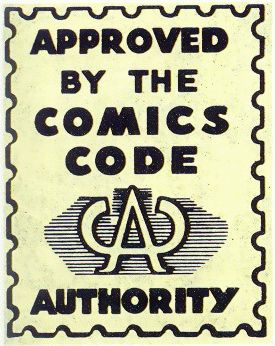 The comic book industry came together and formed the Comic
Magazine Association of America (CMAA). Then they created the Comics
Code Authority (CCA) on October 26th, 1954. This was an organization
that would receive comic stories prior to publishing them and would
censor what they thought would be harmful for minors. They also
had a list of guidelines for publishers to follow before setting pencil
to paper. Publishers that abided by the code got a "stamp" they could
print on the cover of the comic. This stamp was advertised to parents
as meaning the comic book had been censored and was safe for children.
Publishers that didn’t use the Comics Code quickly discovered the
distributors and newsstands wouldn’t handle their books. They would see
entire print runs returned unopened.
Click here to read the CCA Guidelines.
The comic book industry came together and formed the Comic
Magazine Association of America (CMAA). Then they created the Comics
Code Authority (CCA) on October 26th, 1954. This was an organization
that would receive comic stories prior to publishing them and would
censor what they thought would be harmful for minors. They also
had a list of guidelines for publishers to follow before setting pencil
to paper. Publishers that abided by the code got a "stamp" they could
print on the cover of the comic. This stamp was advertised to parents
as meaning the comic book had been censored and was safe for children.
Publishers that didn’t use the Comics Code quickly discovered the
distributors and newsstands wouldn’t handle their books. They would see
entire print runs returned unopened.
Click here to read the CCA Guidelines.
The CMAA was made up of:
John Goldwater - President (Archie Comics)
Jack S. Liebowitz - Vice President (National/DC Comics)
Martin Goodman - Secretary (Timely/Atlas/Marvel Comics)
Leon Harvey - Treasurer (Harvey Comics)
Judge Charles Murphy - Code Administrator
Mrs. Guy Percy Turlock - Code Administrator
Leonard Darvin - Executive Secretary
Henry Edwin Shultz - General Counsel
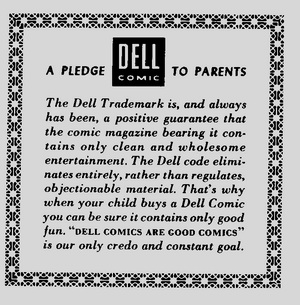 It also included twenty-four of the nation's twenty-seven
publishers of comic books. The three that did not join were Dell,
Classics Illustrated and EC Comics. Dell and Classics Illustrated
had pristine reputations among parents and did not need a comic code
to assure people their books were "safe." Those two publishers were
regularly courted to join the organization but they refused. EC
Owner William Gaines discovered the hard way what not joining the code
could do to a publisher. Wholesalers en mass sent back his horror
comics, sometimes without opening them. Very few would even see a
newsstand. He would cancel the line and start a new line of adult
comics that were tamer. Those too were returned and he was told his
comic books would not be sold unless he joined the CMAA. Gaines would then
join the CMAA and submit his books for approval starting with comics
cover dated May-June 1955. He would have a very hard time getting any
of his books approved. Gaines would realize the entire comic book industry
wanted him out due to his bad showing on national TV. Gaines would quit the
CMAA and the comic book industry. He took one of his comic books, Tales
Calculated to Drive You Mad and turned it into Mad magazine. This was done
in order to keep popular creator Harvey Kurtzman at EC, as he was being
courted by magazine publishers.
It also included twenty-four of the nation's twenty-seven
publishers of comic books. The three that did not join were Dell,
Classics Illustrated and EC Comics. Dell and Classics Illustrated
had pristine reputations among parents and did not need a comic code
to assure people their books were "safe." Those two publishers were
regularly courted to join the organization but they refused. EC
Owner William Gaines discovered the hard way what not joining the code
could do to a publisher. Wholesalers en mass sent back his horror
comics, sometimes without opening them. Very few would even see a
newsstand. He would cancel the line and start a new line of adult
comics that were tamer. Those too were returned and he was told his
comic books would not be sold unless he joined the CMAA. Gaines would then
join the CMAA and submit his books for approval starting with comics
cover dated May-June 1955. He would have a very hard time getting any
of his books approved. Gaines would realize the entire comic book industry
wanted him out due to his bad showing on national TV. Gaines would quit the
CMAA and the comic book industry. He took one of his comic books, Tales
Calculated to Drive You Mad and turned it into Mad magazine. This was done
in order to keep popular creator Harvey Kurtzman at EC, as he was being
courted by magazine publishers.
In 1955 the Senate would write an Interim report on it’s hearings
to summarize their findings. They said the CCA was a good idea and that
if it didn’t have the effect of toning down comic books, they would not
hesitate to revisit the issue and pass legislation.
This was the very last thing Wertham wanted. Some people
examining what Wertham's views make the mistake in assuming he wanted to "clean up" comic books. Nothing
could be further than the truth. Once the CCA was formed they offered Wertham the job to oversee it and
censor comic books as per his wishes. Wertham turned down the job, believing the new code was a
comic industry conspiracy to fool parents and continue publishing the usual material. What
Wertham wanted and fought for the entire time was for comics to be banned from sale or even displayed
to anybody under the age of 15, no matter what the content. Wertham believed the very medium of comics
was bad for kids. He made remarks on how reading word balloons made it difficult for kids to read prose
books. He also didn't like that the colourful sequential art was more exciting to kids than traditional
children's books. In 1955 Wertham wrote an article called "It's Still Murder: What Parents Don't Know
About Comic Books" for the Saturday Review of Literature (April 9th, 1955). He makes this point by
writing:
The most important harm done by comic books is in the field of reading. They interfere with the
elementary mechanisms of learning to read and with the acquisition of the essential perceptual
techniques. Children do not think of reading a comic book as they might "read a book." They "look at" a
comic. They become picture-gazers, because they can get the main points of the stories from the pictures
alone, without bothering to read the words. The damage may show up years later in the disinclination -
or inability - to read a whole book from beginning to end. What right do we have to deprive a whole
generation of children from the wholesome influence that comes from reading good literature?
Also in the article Wertham criticized the Senate for not passing a law like the one
he proposed. He insisted that a connection between Comic Books and Juvenile Delinquency was "well
established" and argued the now censored comics were no better than the uncensored books. Parents were
no longer overly concerned about comic books effect on their kids, be it because of the well publicized
censoring code or because there were other, more interesting issues in the media.
Wertham would go on to write two more crime books, always including a bit about the evils of
comic books within them. In his last book, A Sign of Cain (1966) he would say former comic book readers
were today beating their kids. He would also compare Superman with Lee Harvey Oswald. When the popular and colourful
Batman TV show was running, Wertham went on talk shows to bash comic books again. By the late 60's
early 70's there was a small but dedicated group of comic book fans doing fanzines. Fanzines were
magazines that fans created and distributed, talking about whatever or whoever was the object of their
admiration. They knew who Wertham was and blamed him for everything bad that happened to the comic book
industry since 1954. One fanzine publisher looked up Wertham's whereabouts and did a mail interview
with him. Shortly afterwards Wertham would call up a number of these fanzine writers at home, often
scaring the hell out of them like a childhood boogeyman back from the grave. Wertham was asking for
copies of their fanzines. Some refused fearing the worst, some accepted but were worried another
hatchet job like Seduction of the Innocent would come down on them.
To much surprise Wertham loved the fanzines. In 1973 he would write a book called The World of
Fanzines: A Special Form of Communication. In it he talked about how great it was that a group
of people were communicating about subjects that didn't include violence. He also tried to do a history
of fanzines but got a number of details wrong. By this time fandom had grown enough that there were comic
book conventions being run at major cities across America. After his book about Fanzines came out, Wertham was invited to the 1973 New York
Comic Art Convention. He went because he was told his fans would be there to greet him. But it was a setup, instead of friendly fans he got
heckled and booed off the stage by angry comic collectors. Wertham would die in 1981 at the age of 86.
And as for Senator Estes Kefauver, he would run again for the
Democratic nomination in 1956. He didn't win but he did become the vice president running mate to
winner Adlai Stevenson (Governor of Illinois). They lost to incumbent President Dwight D. Eisenhower in
a landslide. Kefauver would then give up trying to become President and focus on civil-rights and consumer
protection legislation. He was re-elected in 1960 despite being for integration when many in his own party
were still in support of segregation. He also worked to prevent pharmaceutical
companies from selling snake oil medicine and to end price gouging by steel, electrical and drug
companies. He would have a heart attack while speaking on the Senate floor and die two days later in
1963 at the age of 60. While his death was major news, it would soon be overshadowed by the assassination of President John F. Kennedy.
The over all effect of 1954’s events was a cementing of
perception about comic books. The idea being that all comic books are
created for children only and more importantly, that it
should stay that way. Comic book publishers were producing a diverse
amount of material designed for an audience older than their children
readers. Many soldiers read comic books during WWII and continued to
read them when they got back home. It should be noted that much of EC’s
creative talent were WWII vets like their readers. The Romance genre
clearly did reach the female readers. There are reports that 39% of
adult males and 37% of adult females read comic books at this time. But
comic books by and large were still believed to be children’s material.
Just as the industry grew to new audiences, it was cut off at the
knees. As a result of the CCA, newsstand comics did indeed stay within the child
friendly barrier for several decades. Many Americans growing up during
this period still see comic books as children’s entertainment and
wouldn’t be caught dead reading one. It would be a slow, long crawl
until comic books for adults became a significant part of the marketplace.
As for Juvenile Delinquency? Censoring comic books had no effect. Both Juvenile
and Adult crime rates continued to climb through the 60s and 70s, despite the toned down child friendly comics. Whatever was
causing this, it sure wasn't comic books.
Others have suggested that negative reaction to comic books
wasn't so much about comic books, but about children choosing their own entertainment. Parents are naturally
concerned about whatever might be influencing their children's behaviour. Every parent wants their children
to grow up to become good people and elements that may spoil that are fought. This battle would
regularly repeat itself over the years with Rock and Roll, Cartoons, Video Games and more.
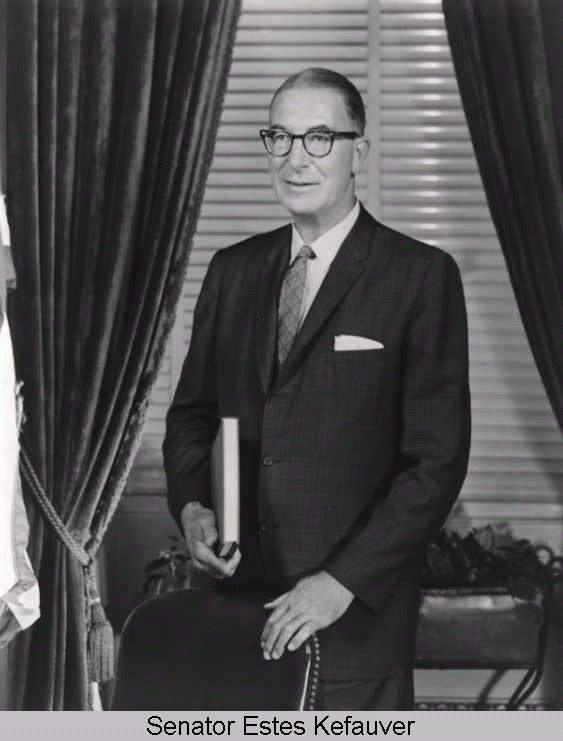 The United States Senate decided to look into Wertham’s
allegation that crime comic books were causing the rise in juvenile delinquency. This was spearheaded
by Senator Estes Kefauver, who had become quite popular nationally because of a
previous Senate investigation into organized crime. With that popularity he tried to become the Democratic Candidate
to run for President in 1952. It didn't work but when Wertham created outrage against the comic
industry he used the Senate investigation process again to "protect children" from harmful
comic books. It was called The Senate Subcommittee to Investigate Juvenile Delinquency. These hearings
were televised and took place on April 21st, 22nd, and June 4th in 1954. Click here to read the Transcripts to these hearings. They called up representatives
from various facets of the comic industry and questioned them about comic books and the industry. While the Senate
claimed neutrality within the hearings, it was pretty clear they were in favour of doing something to
quell the fear and anger among parents. The comic book industry took notice.
The United States Senate decided to look into Wertham’s
allegation that crime comic books were causing the rise in juvenile delinquency. This was spearheaded
by Senator Estes Kefauver, who had become quite popular nationally because of a
previous Senate investigation into organized crime. With that popularity he tried to become the Democratic Candidate
to run for President in 1952. It didn't work but when Wertham created outrage against the comic
industry he used the Senate investigation process again to "protect children" from harmful
comic books. It was called The Senate Subcommittee to Investigate Juvenile Delinquency. These hearings
were televised and took place on April 21st, 22nd, and June 4th in 1954. Click here to read the Transcripts to these hearings. They called up representatives
from various facets of the comic industry and questioned them about comic books and the industry. While the Senate
claimed neutrality within the hearings, it was pretty clear they were in favour of doing something to
quell the fear and anger among parents. The comic book industry took notice. 
