Newsstand Period 1922 - 1955
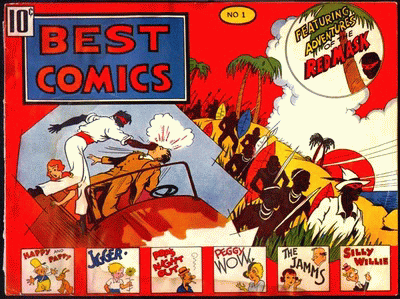 Best Comics #1 would be an unusual comic as it
had to be read sideways. It didn’t sell very well and the company
behind it would soon conform with the industry and do upright comic
books. Comics like this perfectly demonstrate a problem with the
newsstand industry. Trying different formats was usually met with huge marketplace resistance. Over the years artists would bore with the standard size and
would want to do things differently, only to find the market reject it.
Selling comics was more important than an artists desire for variety.
If it didn’t fit on the racks, it didn’t get displayed or sold.
Best Comics #1 would be an unusual comic as it
had to be read sideways. It didn’t sell very well and the company
behind it would soon conform with the industry and do upright comic
books. Comics like this perfectly demonstrate a problem with the
newsstand industry. Trying different formats was usually met with huge marketplace resistance. Over the years artists would bore with the standard size and
would want to do things differently, only to find the market reject it.
Selling comics was more important than an artists desire for variety.
If it didn’t fit on the racks, it didn’t get displayed or sold.
The company that produced this
comic was called Standard Comics.
It was one of four companies owned by Ned Pines. The other names used
was Better, Nedor and Pines Publications. Pines was also a pulp
publisher. During the war he had an allocation of newsprint from
Canada. With that, he was in business.
As business went along Pine
needed more artists to do his comic
books. He was first using artists from the Jack Binder comic shop but
they didn't produce enough material. His son in law Ben W. Sangor knew of this and contacted
his friends in the animation business. They were Jay Morton and Jim
Davis. The two knew a lot of struggling artists working in animation,
constantly moving around trying to follow the work. Through Sangor
those animators would moonlight and produce comic book pages for extra
money. Sangor then sold the work to Ned Pines for his comic book
company. Slowly but surely, some of those stories Sangor kept to himself
so that he could publish them under his own company. That company would eventually be called American Comics Group (ACG).
Among Sangor’s comic shop included Writer Ken Platt would go on
to write Mystery Novels. Artist Everett Raymond Kinstler would do
portraits of American presidents and they currently hang in the White
House. Artist Harry Lazarus would go on to illustrate children's books.
Hy Eisman would go on to work in comic strips, particularly The
Katzenjammer Kids, Popeye and Little Iodine. Last but not least would
be Richard Hughes who would do a lot of the editing and writing under
a variety of names.
Behind the Scenes - Juuuuust Super.
Standard used to be a Sci-Fi pulp
publisher as well. One of their editors was Mort Weisinger who would
later take over the Superman books at DC. Mort was known for being a
very successful editor but also a very rotten one to work for. He had
an ego and believed he could write better than his freelancers. He
was angry that the more successful freelancers made more money than he did.
He was known for chewing out everybody and re-writing everything to fit
his oddball style (which did sell a lot of comics). Writers would pitch
a story idea to him and he would reject it, then give the exact same
story idea to another writer to do. He also moved into the same
neighbourhood as his boss Jack Liebowitz and they became buddy-buddy
allowing Mort to have his way. Weisinger
also did a lot of outside writing for magazine articles and his most
successful book was called "The Contest." It was a shocking expose of
the Beauty Pageants that he used to work for as a Judge. The book was ghost written by comic book
writer Dave Vern. Also coming over with Weisinger was Jack Schiff, who along with Bob Kane tried their
best to imitate Mort’s oddball style on Batman. This didn’t work and
came very close to killing the title.
Behind the Scenes - Science Fiction is a small
world.
Mort Weisinger started up a Bronx
Sci-Fi fan club called The Scienceers. Julie Schwartz joined and the
two convinced the rest of the group to start a Sci-Fi fanzine called
The Time Traveler. Among its subscribers was Jerry Siegel who was so
inspired by it he and Shuster would create their own Sci-Fi fanzine
called Science Fiction. In there debuted the earliest version of Superman.
Weisinger & Schwartz would use their fanzines to make contacts
within the Sci-Fi industry to get the latest news and report it. They would also use
their contacts to become agents for many now famous Sci-Fi authors like Ray
Bradbury, H. P. Lovecraft, Robert A. Heinlein, Edmond Hamilton and many
more. It should be said that it was mainly Julie Schwartz who did this
as Weisinger soon found more lucrative work. What’s amazing about this
is that they were still teenagers when they were literary agents! Both
men would become editors (Weisinger first, then hiring Julie) and
eventually end up at DC Comics. Weisinger and Schwartz would
become Superman’s editors. During the late 50’s and early 60’s, Siegel
would end up working for Weisinger on Superman.
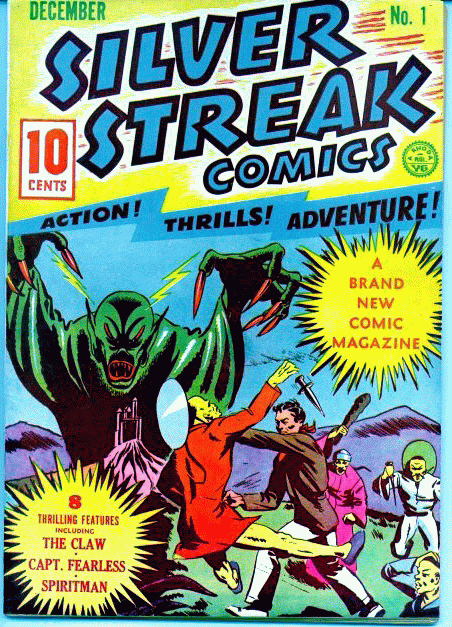
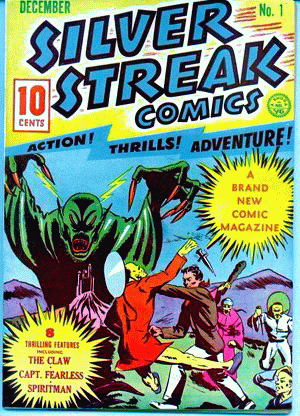 Lev Gleason began publishing
independently with Silver Streak
Comics (Dec. 1939). Unique about this title was that they used some
sort of printing trick to make the title Silver Streak logo metallic
looking. They did this for the first 5 issues and then dropped it. Also
different about this book is that it featured a villain with super
powers. His name is the Claw and his power was that he could grow
really tall. He was often written & drawn by editor Jack Cole. The
biggest hero (he had no powers) from Gleason’s books was called
Daredevil. He first appeared in issue #6.
He wore a half red and blue
costume and he was originally a mute. His creator is Jack Binder. The
two would battle issue after issue, even into Daredevils own solo
title. Daredevil would later battle an even bigger menace, that being
Hitler. But another hero did that first.
Lev Gleason began publishing
independently with Silver Streak
Comics (Dec. 1939). Unique about this title was that they used some
sort of printing trick to make the title Silver Streak logo metallic
looking. They did this for the first 5 issues and then dropped it. Also
different about this book is that it featured a villain with super
powers. His name is the Claw and his power was that he could grow
really tall. He was often written & drawn by editor Jack Cole. The
biggest hero (he had no powers) from Gleason’s books was called
Daredevil. He first appeared in issue #6.
He wore a half red and blue
costume and he was originally a mute. His creator is Jack Binder. The
two would battle issue after issue, even into Daredevils own solo
title. Daredevil would later battle an even bigger menace, that being
Hitler. But another hero did that first.
Silver Streak Comics #1 is in the public domain and you can download and read it by clicking here. (37.9 MB - Scanned Microfiche)
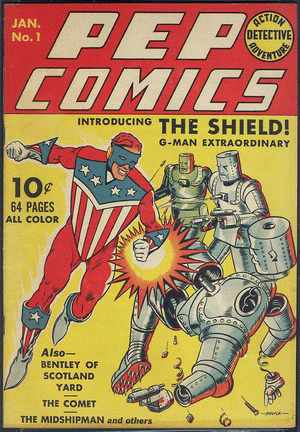 MLJ Magazines first success
would be a hero called The Shield.
His first appearance would be in Pep Comics #1, January 1940. He would
be the first patriotic hero all dressed up in Red, White and Blue. The
character was created by Robert Kanigher, Harry Shorten and Irv Novick.
The Shield was Joe Higgins, a G-Man that reported to a FBI
Chief who looked exactly like J. Edgar Hoover. He wore a suit of armor
and had a chemical process applied to him that gave him a number of
powers. He had Super Strength, Invulnerability; he could hold his
breath a long time and more. What’s really interesting about this title
was in issue #4 they have Pearl Harbor bombed by Airplanes. This issue
came out 23 months before Pearl Harbor was actually bombed! The
villains that did it were fictional "Masconians" who looked and talked
like stereotypical German villains. Since MLJ Magazine is still in
publishing (as Archie Comics) the Shield does make return appearances
from time to time.
MLJ Magazines first success
would be a hero called The Shield.
His first appearance would be in Pep Comics #1, January 1940. He would
be the first patriotic hero all dressed up in Red, White and Blue. The
character was created by Robert Kanigher, Harry Shorten and Irv Novick.
The Shield was Joe Higgins, a G-Man that reported to a FBI
Chief who looked exactly like J. Edgar Hoover. He wore a suit of armor
and had a chemical process applied to him that gave him a number of
powers. He had Super Strength, Invulnerability; he could hold his
breath a long time and more. What’s really interesting about this title
was in issue #4 they have Pearl Harbor bombed by Airplanes. This issue
came out 23 months before Pearl Harbor was actually bombed! The
villains that did it were fictional "Masconians" who looked and talked
like stereotypical German villains. Since MLJ Magazine is still in
publishing (as Archie Comics) the Shield does make return appearances
from time to time.
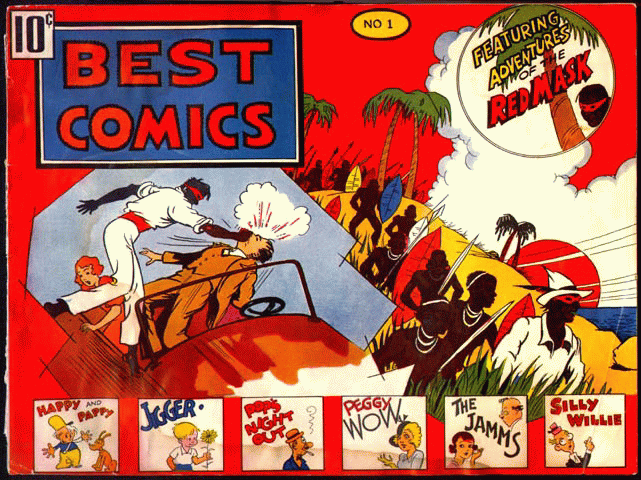 Best Comics #1 would be an unusual comic as it
had to be read sideways. It didn’t sell very well and the company
behind it would soon conform with the industry and do upright comic
books. Comics like this perfectly demonstrate a problem with the
newsstand industry. Trying different formats was usually met with huge marketplace resistance. Over the years artists would bore with the standard size and
would want to do things differently, only to find the market reject it.
Selling comics was more important than an artists desire for variety.
If it didn’t fit on the racks, it didn’t get displayed or sold.
Best Comics #1 would be an unusual comic as it
had to be read sideways. It didn’t sell very well and the company
behind it would soon conform with the industry and do upright comic
books. Comics like this perfectly demonstrate a problem with the
newsstand industry. Trying different formats was usually met with huge marketplace resistance. Over the years artists would bore with the standard size and
would want to do things differently, only to find the market reject it.
Selling comics was more important than an artists desire for variety.
If it didn’t fit on the racks, it didn’t get displayed or sold.